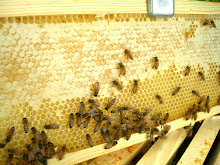
Here is an excellent article (complete with audio) about research being done on detecting the health of a hive by its sounds and sound levels. It also makes clear the importance and contributions of bees to agriculture, to the environment and to our world in general. (If an active link doesn't appear below, just copy and past the URL into the subject bar of your web browser.)
http://www.bbc.co.uk/news/technology-16114890
Wednesday, February 1, 2012


Sunday, January 15, 2012
Dead hive inspection
It's a beautiful, crisp Sunday afternoon in January. The sunshine made it warm enough that I wanted to go outside to do a better inspection of Sweet Beezus, the dead hive. I removed five frames that contained either honey or brood cells and placed them in a sealed bag to bring indoors for a closer look later.
On the recommendation of Linda Tillman, a local master beekeeper who maintains a very thorough and informative blog -- and who doesn't mind answering a novice's questions -- I did the "toothpick test" for American Foulbrood. AFB is a spore-producing disease that systematically destroys a hive by infecting the bee larvae. One of the first signs of AFB is sunken capped brood (sometimes with small chew marks in the caps) and "ropey" larvae. The test is simple: insert a toothpick into a capped cell, wiggle it around a bit and pull it out; if the toothpick is slimed with a mucous-like, ropey substance, the hive's infected with AFB. There is usually a foul odor to accompany this.
Thankfully, I found neither ropey larvae nor a foul odor in Sweet Beezus. There was very little capped lavae at all. And when I took the supers off and sifted through the dead bees on the screened bottom board, I couldn't find the queen. So, the hive was without a queen for quite some time.
In the past, I've always been afraid to keep the hive open for more than a very few minutes in case the queen escaped. One of the most important lessons I've learned from this experience with hive death is that I cannot be afraid to open up the hives all the way down and examine all of the frames once in a while to be certain that there IS a queen and that she's laying eggs.
On the positive side, since there is no evidence of AFB, I can use this hive again. If it had been infected, I would have to burn the frames and at least scorch the insides of all of the hive components, if not burn them all, to make it safe for new bees. Also, according to Linda, I can use the existing frames that already have comb drawn out on them, courtesy of the bees that are now gone. This will make a great home for a new colony because they won't have to work quite as hard to get things going and the queen will have cells ready and waiting for eggs.
I had enough smoke left in the smoker to open one of the other hives for a few minutes, so I took a peek in Rocky. The Rocky girls have been busy eating the fondant and pollen patties, and when I took out some of the frames in the top super, they were LOADED with honey! It's a beautiful golden color and smelled so good. Too bad I can't harvest it for myself, but this is their food source for the winter.
On the recommendation of Linda Tillman, a local master beekeeper who maintains a very thorough and informative blog -- and who doesn't mind answering a novice's questions -- I did the "toothpick test" for American Foulbrood. AFB is a spore-producing disease that systematically destroys a hive by infecting the bee larvae. One of the first signs of AFB is sunken capped brood (sometimes with small chew marks in the caps) and "ropey" larvae. The test is simple: insert a toothpick into a capped cell, wiggle it around a bit and pull it out; if the toothpick is slimed with a mucous-like, ropey substance, the hive's infected with AFB. There is usually a foul odor to accompany this.
Thankfully, I found neither ropey larvae nor a foul odor in Sweet Beezus. There was very little capped lavae at all.
 And when I took the supers off and sifted through the dead bees on the screened bottom board, I couldn't find the queen. So, the hive was without a queen for quite some time.
 In the past, I've always been afraid to keep the hive open for more than a very few minutes in case the queen escaped. One of the most important lessons I've learned from this experience with hive death is that I cannot be afraid to open up the hives all the way down and examine all of the frames once in a while to be certain that there IS a queen and that she's laying eggs.
On the positive side, since there is no evidence of AFB, I can use this hive again. If it had been infected, I would have to burn the frames and at least scorch the insides of all of the hive components, if not burn them all, to make it safe for new bees. Also, according to Linda, I can use the existing frames that already have comb drawn out on them, courtesy of the bees that are now gone. This will make a great home for a new colony because they won't have to work quite as hard to get things going and the queen will have cells ready and waiting for eggs.
I had enough smoke left in the smoker to open one of the other hives for a few minutes, so I took a peek in Rocky. The Rocky girls have been busy eating the fondant and pollen patties, and when I took out some of the frames in the top super, they were LOADED with honey! It's a beautiful golden color and smelled so good. Too bad I can't harvest it for myself, but this is their food source for the winter.
Saturday, January 7, 2012
Mourning a loss.
A couple of years ago, I met a fellow novice beekeeper who had lost his two hives during the very cold winter. Sadly, he found the bees in clusters on their frames in the center of the hives, as if they were huddled together to keep warm. We both assumed that the bees had died due to an extended frigid period (for Georgia, anyway) that January, which could certainly be true. But there are many other reasons honeybees die, including starvation, pests, diseases, loss of the queen or old queen...all of which stress the bees.

This morning, I made a sad discovery of my own. I lost Sweet Beezus — the girls were dead, in clusters on the frames and below the hive. I pulled out frames from both supers and didn't see any signs of mites, although there were a few dead small hive beetles. No sign of Foulbrood, either. There was a good bit of honey stored, so my best guess is that either the girls couldn't withstand the cold temperatures last week or the queen died (or was incapable of laying new eggs).
This is my first experience with hive loss, so I'll have to research how to clean out the hive and what to do next — whether to order a new package of bees or try to attract a swarm to live there.

Another new experience: I made fondant candy to feed the bees. This is easier than trying to supply them with sugar syrup, which can freeze during the winter months. The fondant is made by heating a mixture of sugar, corn syrup and water to 238° and then letting it cool before beating it until it turns white. The candy solidifies, but is soft and easy to cut. In addition to the fondant, I wanted to feed the bees some protein in the form of pollen patties (dark strips pictured on left next to fondant).

Both the Apollo and Rocky bees seemed healthy, thank goodness. When I took the covers off each hive, the girls started buzzing and coming up to investigate. Here's a photo of the Rocky bees coming up through the inner cover, happy to discover someone had provided dinner and dessert.
R.I.P. sweet girls of Sweet Beezus. Thank you for making some wonderful honey. I'll do my best to honor your memory by repopulating your hive!

This morning, I made a sad discovery of my own. I lost Sweet Beezus — the girls were dead, in clusters on the frames and below the hive. I pulled out frames from both supers and didn't see any signs of mites, although there were a few dead small hive beetles. No sign of Foulbrood, either. There was a good bit of honey stored, so my best guess is that either the girls couldn't withstand the cold temperatures last week or the queen died (or was incapable of laying new eggs).
This is my first experience with hive loss, so I'll have to research how to clean out the hive and what to do next — whether to order a new package of bees or try to attract a swarm to live there.

Another new experience: I made fondant candy to feed the bees. This is easier than trying to supply them with sugar syrup, which can freeze during the winter months. The fondant is made by heating a mixture of sugar, corn syrup and water to 238° and then letting it cool before beating it until it turns white. The candy solidifies, but is soft and easy to cut. In addition to the fondant, I wanted to feed the bees some protein in the form of pollen patties (dark strips pictured on left next to fondant).

Both the Apollo and Rocky bees seemed healthy, thank goodness. When I took the covers off each hive, the girls started buzzing and coming up to investigate. Here's a photo of the Rocky bees coming up through the inner cover, happy to discover someone had provided dinner and dessert.
R.I.P. sweet girls of Sweet Beezus. Thank you for making some wonderful honey. I'll do my best to honor your memory by repopulating your hive!
Sunday, October 23, 2011
Cleaning house!
There was not a lot happening with the hives in the past few weeks worthy of a post. However, now that the weather's turned cool, there are some interesting activities to report.
For the past week or so, I've noticed a few dead bees and white larvae at the entrance to each hive; mysteriously they vanished within a few hours. Since the numbers weren't large, I wasn't too alarmed (I knew the hives weren't being robbed) — but I did open my beekeeping books to do a little research. I learned that, since bees are very hygienic creatures, they take advantage of mild weather days to do some housekeeping. The girls drag dead bees and larvae out of the hive and then the bodies are carried away for disposal. Mystery solved.
This morning I did a quick inspection. Sweet Beezus has a few frames of honey along with a few frames of brood in the top super! When I harvest the honey in a few weeks, I'll take the frames that are honey-only and leave the brood frames. Way to go, first year bees!
Apollo also has some honey in the top super, but only on the frames in the center of the box. I'm a little surprised the Apollo girls haven't stored more, but then they had better things to do this spring and summer. They were busy, swarming more than once and then defending their hive against would-be robbers and other intruders like bumblebees and yellow jackets.
The Rocky girls were angry this morning when I opened their hive, so I was hopeful that meant they were protecting a supply of honey. No luck, though — bees are in the top super building out comb but nothing has been stored. Haven already given up their honey supply earlier this summer, they're probably holding a grudge against me!
There are small hive beetles present in all three hives, so on harvest day, I'll install some traps. It will also be time to reduce the hive entrances and put in some pollen patties for the girls to eat during the winter. I think the extra protein from the patties, along with installing the beetle traps and reducing the hive entrances to better keep out the cold air, helped keep my girls healthy last winter.
For the past week or so, I've noticed a few dead bees and white larvae at the entrance to each hive; mysteriously they vanished within a few hours. Since the numbers weren't large, I wasn't too alarmed (I knew the hives weren't being robbed) — but I did open my beekeeping books to do a little research. I learned that, since bees are very hygienic creatures, they take advantage of mild weather days to do some housekeeping. The girls drag dead bees and larvae out of the hive and then the bodies are carried away for disposal. Mystery solved.
This morning I did a quick inspection. Sweet Beezus has a few frames of honey along with a few frames of brood in the top super! When I harvest the honey in a few weeks, I'll take the frames that are honey-only and leave the brood frames. Way to go, first year bees!
Apollo also has some honey in the top super, but only on the frames in the center of the box. I'm a little surprised the Apollo girls haven't stored more, but then they had better things to do this spring and summer. They were busy, swarming more than once and then defending their hive against would-be robbers and other intruders like bumblebees and yellow jackets.
The Rocky girls were angry this morning when I opened their hive, so I was hopeful that meant they were protecting a supply of honey. No luck, though — bees are in the top super building out comb but nothing has been stored. Haven already given up their honey supply earlier this summer, they're probably holding a grudge against me!
There are small hive beetles present in all three hives, so on harvest day, I'll install some traps. It will also be time to reduce the hive entrances and put in some pollen patties for the girls to eat during the winter. I think the extra protein from the patties, along with installing the beetle traps and reducing the hive entrances to better keep out the cold air, helped keep my girls healthy last winter.
Sunday, July 24, 2011
Sweetness!
It was finally time to collect honey from the Rocky hive this week. With the smoker, wheelbarrow and a sheet, I went out early Thursday morning while the day was still cool enough to tolerate.
Unfortunately, the escape screen had not worked as well as expected and there were still quite a few bees in the honey super. I decided the best course of action was to remove one frame at a time, using the smoker and bee brush to gently move the bees off. When each frame was bee-free, I put it in the wheelbarrow and covered it with the sheet. Pretty soon, I had seven honey-filled frames (the eighth and final frame had built-out come but no honey). I hurried them into the garage and shut the door to keep the Rocky bees at bay. Bees will automatically try to retrieve the honey that you rob from their hives, and will follow it wherever it goes!

The two-can filtering system works great for a small beekeeping operation like mine. It's easy to use the cold knife to scrape the wax and honey into the top can. And then the honey runs down through the filters and into the bottom can, which has a gate for filling the jars. Here's a photo of just a small portion of the harvest.

Later I took the empty frames, inserted them back in their box and set it out on a table in the yard. The bees were immediately all over it, cleaning every vestige of honey left behind on those frames. Honeybees are such efficient creatures. Nothing goes to waste.
Unfortunately, the escape screen had not worked as well as expected and there were still quite a few bees in the honey super. I decided the best course of action was to remove one frame at a time, using the smoker and bee brush to gently move the bees off. When each frame was bee-free, I put it in the wheelbarrow and covered it with the sheet. Pretty soon, I had seven honey-filled frames (the eighth and final frame had built-out come but no honey). I hurried them into the garage and shut the door to keep the Rocky bees at bay. Bees will automatically try to retrieve the honey that you rob from their hives, and will follow it wherever it goes!

The two-can filtering system works great for a small beekeeping operation like mine. It's easy to use the cold knife to scrape the wax and honey into the top can. And then the honey runs down through the filters and into the bottom can, which has a gate for filling the jars. Here's a photo of just a small portion of the harvest.

Later I took the empty frames, inserted them back in their box and set it out on a table in the yard. The bees were immediately all over it, cleaning every vestige of honey left behind on those frames. Honeybees are such efficient creatures. Nothing goes to waste.
Sunday, July 17, 2011
The waxy element.
For the past couple of days, we've experienced unseasonably cool temperatures for July in Georgia, making it much more appealing to suit up and inspect the hives this morning. I made sure there was plenty of fuel in the smoker and took an escape screen with me.
The Sweet BEEzus girls have moved up into their shallow super on top, but it looks like they are only storing pollen there so far. The Apollo bees are making honey in their top super, but very little of it is capped off.
I saved Rocky for last. Despite the smoke, these girls are feisty and they did not like it one bit when I took the cover off their hive and started poking around in the top super. The buzz was angry!
Their honey super is very heavy, and the middle frames are full of honey and mostly capped. Even though the end frames are not filled in, I decided to go ahead and insert the escape screen today (for more about how the escape screen works to separate the bees from the honey box, see http://beewaxingeloquent-helen.blogspot.com/2010/11/honey-harvest.html). I will be able to harvest this honey in a few days.
My decision was based on the sheer difficulty of being able to work with this hive. The amount of wax and propolis the girls are making have tightly sealed together not only all of the frames in the honey super, but also the inner and outer covers to the hive. It takes some muscle to pry things apart and even more finesse not to break anything!
So, honey harvest and photos coming soon. Once I've un-gummed up the works.
The Sweet BEEzus girls have moved up into their shallow super on top, but it looks like they are only storing pollen there so far. The Apollo bees are making honey in their top super, but very little of it is capped off.
I saved Rocky for last. Despite the smoke, these girls are feisty and they did not like it one bit when I took the cover off their hive and started poking around in the top super. The buzz was angry!
Their honey super is very heavy, and the middle frames are full of honey and mostly capped. Even though the end frames are not filled in, I decided to go ahead and insert the escape screen today (for more about how the escape screen works to separate the bees from the honey box, see http://beewaxingeloquent-helen.blogspot.com/2010/11/honey-harvest.html). I will be able to harvest this honey in a few days.
My decision was based on the sheer difficulty of being able to work with this hive. The amount of wax and propolis the girls are making have tightly sealed together not only all of the frames in the honey super, but also the inner and outer covers to the hive. It takes some muscle to pry things apart and even more finesse not to break anything!
So, honey harvest and photos coming soon. Once I've un-gummed up the works.
Subscribe to:
Posts (Atom)