I left my hives alone for most of the summer, noting that they both were busy and humming. In September, I lifted the back of each hive. Both were almost too heavy for me to move, signaling they were full of bees and probably some honey. But what a difference a couple of months makes.
Today I went out to winterize the hives. With Atlanta's moderate climate, there isn't a lot of winterizing to do, unlike what beekeepers are tasked with in colder climates. Generally, I remove the extra supers from the top of a hive (those are usually empty), make sure the hive beetle trap is in place and doing its job, and insert an entrance reducer to cut down on the cold air flow.
Hive #2, which had not been named yet due to my superstition about waiting to be sure it's surviving, has been ravaged by wax moths. I won't document that in photos since I've shown it before, but suffice it to say that wax moths wreak a special, messy kind of havoc in a hive. There was a small cluster of honeybees left inside, but there is nothing I can do to save them. I took off two of the supers and then closed up the hive. On a warm winter day, I'll probably go out and dismantle everything. Most of that equipment will be unusable again.
On to Gloriana's Gold, which has a much happier, healthier story. The top super was empty, but clean. When I removed it, the super below began to hum and bees began moving up toward me to see what was going on. Good thing I'd checked the smoker and added some fuel before I started working on this one! This hive isn't exactly docile, but the smoke and the mid-50's temperature kept them quieter than usual.
The GG girls have been busy! They sealed off the hive beetle trap with propolis, so I removed it and made a mental note to order some more — as soon as they come, I'll install a fresh one. The bees have also made their own entrance reducer (see photo above) out of light-colored propolis! This is something I've never seen before, but have learned is common. Some bees just like to do their own winterizing.
Finally, the best news of all...Gloriana's Gold is chock full of honey in two supers. I'm debating whether to take out a few frames before the weather turns too cold for opening the hive. I may just leave it all in there for the girls to feed on until spring.
And yes, I will probably rebuild in the spring. After clearing out part of the side yard, there is more room and a level place for some hives, so I'm thinking of starting 2-3 more.
Showing posts with label beekeeping. Show all posts
Saturday, December 3, 2016
Wednesday, March 30, 2016
Gloriana's Gold is Thriving
This morning I went out to cut away some shrub and weed overgrowth around the hives and did a quick inspection of Gloriana's Gold (GG). This hive is composed of one deep with two medium supers on top of it. I was excited to lift the back of the hive and feel its weight — it is chock full of bees!
The top super has honey in the outer frames and baby bees being laid in the middle. The laying pattern is a little spotty. I think that may be because the queen is laying more in the middle super, which is definitely heavier with brood.
Last, I pulled out the IPM sheet for a check. The IPM (Integrated Pest Management) sheet fits below the screened bottom board and helps a beekeeper see and monitor a mite infestation. As far as I can see, there wasn't a mite problem, just heavily coated with pollen. Oh, and also a wax moth or two that the girls killed and mummified.
I'm excited about traveling to Temple, Ga. this weekend to pick up a nuc from Georgia Honey Bee Company. I've got an empty hive and it needs fillin'! Photos to come.
The top super has honey in the outer frames and baby bees being laid in the middle. The laying pattern is a little spotty. I think that may be because the queen is laying more in the middle super, which is definitely heavier with brood.
Last, I pulled out the IPM sheet for a check. The IPM (Integrated Pest Management) sheet fits below the screened bottom board and helps a beekeeper see and monitor a mite infestation. As far as I can see, there wasn't a mite problem, just heavily coated with pollen. Oh, and also a wax moth or two that the girls killed and mummified.
I'm excited about traveling to Temple, Ga. this weekend to pick up a nuc from Georgia Honey Bee Company. I've got an empty hive and it needs fillin'! Photos to come.
Sunday, February 9, 2014
Fond of Fondant
It's a beautiful and mild (60 degrees) winter day in Roswell...and with colder temperatures and a "possible weather event" coming later this week, I thought it would be a good time to give my bees a little winter boost in the form of fondant.
Fondant is a simple sugar candy. Here is my recipe:
2 cups white sugar
2 Tbsp. light corn syrup
1-1/2 cups boiling water
Combine and heat ingredients, stirring until sugar dissolves. Then, heat — without stirring — until the mixture reaches 238 degrees on a candy thermometer (or until medium ball stage).
Pour into a bowl and let cool to touch. Beat the mixture until it's light and pour into a wax paper-lined mold.
As you can see here, I let the fondant cool a bit in a wax paper-lined loaf pan.
Later I removed it from the pan, lifting it by the wax paper. I put another sheet of wax paper on top and rolled the fondant out into a thin sheet, which I then cut in half. The bees will get half the fondant today and, whenever they finish it off, I'll give them the other half.
As soon as I placed the sheet of fondant on top of the frames, the bees were on it. (The darker substance on the left is a pollen patty that I placed in the hive a few weeks ago for a protein source.)
When I replaced the inner cover, a few of the girls peeked out at me and the sunshine. And then it was time to replace the outer cover and seal up the hive so the bees can eat and get back to their important work.
Fondant is a simple sugar candy. Here is my recipe:
2 cups white sugar
2 Tbsp. light corn syrup
1-1/2 cups boiling water
Combine and heat ingredients, stirring until sugar dissolves. Then, heat — without stirring — until the mixture reaches 238 degrees on a candy thermometer (or until medium ball stage).
Pour into a bowl and let cool to touch. Beat the mixture until it's light and pour into a wax paper-lined mold.
As you can see here, I let the fondant cool a bit in a wax paper-lined loaf pan.
Later I removed it from the pan, lifting it by the wax paper. I put another sheet of wax paper on top and rolled the fondant out into a thin sheet, which I then cut in half. The bees will get half the fondant today and, whenever they finish it off, I'll give them the other half.
As soon as I placed the sheet of fondant on top of the frames, the bees were on it. (The darker substance on the left is a pollen patty that I placed in the hive a few weeks ago for a protein source.)
When I replaced the inner cover, a few of the girls peeked out at me and the sunshine. And then it was time to replace the outer cover and seal up the hive so the bees can eat and get back to their important work.
Friday, September 13, 2013
Starving!
I was so thankful to receive dire warnings via Facebook and email from Metro Atlanta Beekeepers Association, as well as Brushy Mountain Beekeeping and Pigeon Mountain Trading Co. about the immediate need to feed the bees! Even though the season is deceptively warm and we're lured into thinking the bees have plenty of food, an actual lack of nectar flow has put Southern bees into starvation mode.
Yesterday I made a big batch of sugar syrup and went out to inspect Apollo, my only remaining hive. Sure enough, when I pulled off the inner cover, there was a cluster of about 100 dead bees on the top super. Sad, sad, sad. This super, which was full of honey a couple of months ago, was now almost devoid of honey. The bees were STARVING and had been feeding off their stores.
On the positive side, the queen had apparently made it up into this super and been hard at work laying eggs. Six of the frames were full of beautifully capped brood, eggs and larvae, and the laying pattern looked just as it should. My sweet little honeybees need a food source so that they can, in turn, nourish these baby bees and make a strong colony.
The girls went through a large plastic feeder of syrup yesterday and they are now working on a small feeder this morning. Probably time to think about ordering a feeder that can supply them for at least a few days at a time.
Hope I've dodged a bullet and kept Apollo going — I'd hate to lose yet another hive.
Yesterday I made a big batch of sugar syrup and went out to inspect Apollo, my only remaining hive. Sure enough, when I pulled off the inner cover, there was a cluster of about 100 dead bees on the top super. Sad, sad, sad. This super, which was full of honey a couple of months ago, was now almost devoid of honey. The bees were STARVING and had been feeding off their stores.
On the positive side, the queen had apparently made it up into this super and been hard at work laying eggs. Six of the frames were full of beautifully capped brood, eggs and larvae, and the laying pattern looked just as it should. My sweet little honeybees need a food source so that they can, in turn, nourish these baby bees and make a strong colony.
The girls went through a large plastic feeder of syrup yesterday and they are now working on a small feeder this morning. Probably time to think about ordering a feeder that can supply them for at least a few days at a time.
Hope I've dodged a bullet and kept Apollo going — I'd hate to lose yet another hive.
Thursday, March 7, 2013
A Tale of Two Hives
This has been a challenging winter for both hives. I've learned more about the pests that plague honeybees and about the value of regular hive inspections, winter feeding and "re-queening." Let's just say I've learned these lessons the hard way.
Apollo
Apollo is my original hive, which I started with a package back in May 2010. This hive has overcome numerous problems including multiple swarms, one particularly brutal and prolonged cold snap and several different pests.
A couple of months ago, I pulled off the cover and noticed that there was a white substance underneath the inner cover. It looked like expandable foam sealant, actually. I had a very hard time prying the inner cover off the top super, and when I finally did, was horrified to see a thick layer of white cocoons. Apollo had a wax moth infestation. (Click on the photo below if you'd like to see an enlarged image.)

Wax moths are extremely destructive insects, spinning webs throughout the hive and their larvae destroying not only the brood comb but also the hive equipment. Here is a picture of the damage done to the super and frames by larvae burrowing into the wood.

I removed the top super — which could not be salvaged — and cleaned out as much webbing and other wax moth debris as I could, put in some fondant for the bees to feed on, closed the cover and hoped for the best. Although I've been told that honeybees are likely to abscond from a wax moth-infested hive, the Apollo bees chose to stay and, miraculously, appear to be thriving right now.
Recently I attended a lecture given by honeybee expert Dr. Keith Delaplane about colony collapse disorder and what the disappearance of honeybees and other pollinators means to the environment and to our way of life. (Check out this informative editorial, "On Einstein, Bees, and Survival of the Human Race.")
Afterward, I was able to ask Dr. D. about my wax moth issue and he just smiled and said, "Wax moths are generally only a symptom of a bigger problem. If the hive is healthy and the bees are robust, they can fend off wax moths pretty easily." So, we talked about the probability of Varroa mites (at least the small hive beetles are under control, I'm glad to say), or... an unhealthy or dead queen. He suggested I "re-queen" the hive, which involves killing the old queen and introducing a new, healthy queen. I shuddered visibly, I guess, because Dr. D. simply smiled again and wished me luck.
For now, I'm watching and waiting to see if Apollo has the strength to keep on keepin' on. There are hundreds of girls out and about lately, flying around in the sunshine on these warm afternoons, so I'm thinking they're gonna make it.
Rocky
Sadly, today I discovered that the Rocky hive is dead. I'd suspected as much because there have been so few bees visibly out and about, nowhere near as many as Apollo. I'm sad and feeling like a "bad mom" because if I'd paid more attention sooner, I might have been able to salvage the situation. I could've re-queened this hive and fed the bees with not only fondant, but also pollen patties.
Bees need a food source during the winter, even in Atlanta where there is some pollen available for foraging pretty much year-round. This year, I didn't give them pollen patties and I feel like this was part of the reason for hive failure.
So, I fell down on the job and it's a hard lesson learned again after losing the Sweet Beezus hive last winter.
Plan B
I've got a package of bees on order to repopulate Sweet B, and those bees will arrive in May. In the meantime, I've signed up to attend a hive inspection tour offered by the Metro Atlanta Beekeepers Association in a few weeks. The inspection of multiple hives will be conducted by a master beekeeper and we'll be able to observe and learn what to look for in determining whether the hive is healthy or has problems.
Also, I found out that, as a MABA member, I can put my name on the "swarm list" and possibly be the recipient of a swarm of bees that MABA beekeepers are routinely called on to collect from people's yards, businesses, school playgrounds, etc. As often as my own Apollo bees have swarmed in the past, I might be lucky enough to collect my own swarm again this spring and repopulate the Rocky hive. And that's an interesting idea in itself, because Rocky was started from an Apollo swarm the first year I began beekeeping.
Apollo
Apollo is my original hive, which I started with a package back in May 2010. This hive has overcome numerous problems including multiple swarms, one particularly brutal and prolonged cold snap and several different pests.
A couple of months ago, I pulled off the cover and noticed that there was a white substance underneath the inner cover. It looked like expandable foam sealant, actually. I had a very hard time prying the inner cover off the top super, and when I finally did, was horrified to see a thick layer of white cocoons. Apollo had a wax moth infestation. (Click on the photo below if you'd like to see an enlarged image.)

Wax moths are extremely destructive insects, spinning webs throughout the hive and their larvae destroying not only the brood comb but also the hive equipment. Here is a picture of the damage done to the super and frames by larvae burrowing into the wood.

I removed the top super — which could not be salvaged — and cleaned out as much webbing and other wax moth debris as I could, put in some fondant for the bees to feed on, closed the cover and hoped for the best. Although I've been told that honeybees are likely to abscond from a wax moth-infested hive, the Apollo bees chose to stay and, miraculously, appear to be thriving right now.
Recently I attended a lecture given by honeybee expert Dr. Keith Delaplane about colony collapse disorder and what the disappearance of honeybees and other pollinators means to the environment and to our way of life. (Check out this informative editorial, "On Einstein, Bees, and Survival of the Human Race.")
Afterward, I was able to ask Dr. D. about my wax moth issue and he just smiled and said, "Wax moths are generally only a symptom of a bigger problem. If the hive is healthy and the bees are robust, they can fend off wax moths pretty easily." So, we talked about the probability of Varroa mites (at least the small hive beetles are under control, I'm glad to say), or... an unhealthy or dead queen. He suggested I "re-queen" the hive, which involves killing the old queen and introducing a new, healthy queen. I shuddered visibly, I guess, because Dr. D. simply smiled again and wished me luck.
For now, I'm watching and waiting to see if Apollo has the strength to keep on keepin' on. There are hundreds of girls out and about lately, flying around in the sunshine on these warm afternoons, so I'm thinking they're gonna make it.
Rocky
Sadly, today I discovered that the Rocky hive is dead. I'd suspected as much because there have been so few bees visibly out and about, nowhere near as many as Apollo. I'm sad and feeling like a "bad mom" because if I'd paid more attention sooner, I might have been able to salvage the situation. I could've re-queened this hive and fed the bees with not only fondant, but also pollen patties.
Bees need a food source during the winter, even in Atlanta where there is some pollen available for foraging pretty much year-round. This year, I didn't give them pollen patties and I feel like this was part of the reason for hive failure.
So, I fell down on the job and it's a hard lesson learned again after losing the Sweet Beezus hive last winter.
Plan B
I've got a package of bees on order to repopulate Sweet B, and those bees will arrive in May. In the meantime, I've signed up to attend a hive inspection tour offered by the Metro Atlanta Beekeepers Association in a few weeks. The inspection of multiple hives will be conducted by a master beekeeper and we'll be able to observe and learn what to look for in determining whether the hive is healthy or has problems.
Also, I found out that, as a MABA member, I can put my name on the "swarm list" and possibly be the recipient of a swarm of bees that MABA beekeepers are routinely called on to collect from people's yards, businesses, school playgrounds, etc. As often as my own Apollo bees have swarmed in the past, I might be lucky enough to collect my own swarm again this spring and repopulate the Rocky hive. And that's an interesting idea in itself, because Rocky was started from an Apollo swarm the first year I began beekeeping.
Sunday, October 23, 2011
Cleaning house!
There was not a lot happening with the hives in the past few weeks worthy of a post. However, now that the weather's turned cool, there are some interesting activities to report.
For the past week or so, I've noticed a few dead bees and white larvae at the entrance to each hive; mysteriously they vanished within a few hours. Since the numbers weren't large, I wasn't too alarmed (I knew the hives weren't being robbed) — but I did open my beekeeping books to do a little research. I learned that, since bees are very hygienic creatures, they take advantage of mild weather days to do some housekeeping. The girls drag dead bees and larvae out of the hive and then the bodies are carried away for disposal. Mystery solved.
This morning I did a quick inspection. Sweet Beezus has a few frames of honey along with a few frames of brood in the top super! When I harvest the honey in a few weeks, I'll take the frames that are honey-only and leave the brood frames. Way to go, first year bees!
Apollo also has some honey in the top super, but only on the frames in the center of the box. I'm a little surprised the Apollo girls haven't stored more, but then they had better things to do this spring and summer. They were busy, swarming more than once and then defending their hive against would-be robbers and other intruders like bumblebees and yellow jackets.
The Rocky girls were angry this morning when I opened their hive, so I was hopeful that meant they were protecting a supply of honey. No luck, though — bees are in the top super building out comb but nothing has been stored. Haven already given up their honey supply earlier this summer, they're probably holding a grudge against me!
There are small hive beetles present in all three hives, so on harvest day, I'll install some traps. It will also be time to reduce the hive entrances and put in some pollen patties for the girls to eat during the winter. I think the extra protein from the patties, along with installing the beetle traps and reducing the hive entrances to better keep out the cold air, helped keep my girls healthy last winter.
For the past week or so, I've noticed a few dead bees and white larvae at the entrance to each hive; mysteriously they vanished within a few hours. Since the numbers weren't large, I wasn't too alarmed (I knew the hives weren't being robbed) — but I did open my beekeeping books to do a little research. I learned that, since bees are very hygienic creatures, they take advantage of mild weather days to do some housekeeping. The girls drag dead bees and larvae out of the hive and then the bodies are carried away for disposal. Mystery solved.
This morning I did a quick inspection. Sweet Beezus has a few frames of honey along with a few frames of brood in the top super! When I harvest the honey in a few weeks, I'll take the frames that are honey-only and leave the brood frames. Way to go, first year bees!
Apollo also has some honey in the top super, but only on the frames in the center of the box. I'm a little surprised the Apollo girls haven't stored more, but then they had better things to do this spring and summer. They were busy, swarming more than once and then defending their hive against would-be robbers and other intruders like bumblebees and yellow jackets.
The Rocky girls were angry this morning when I opened their hive, so I was hopeful that meant they were protecting a supply of honey. No luck, though — bees are in the top super building out comb but nothing has been stored. Haven already given up their honey supply earlier this summer, they're probably holding a grudge against me!
There are small hive beetles present in all three hives, so on harvest day, I'll install some traps. It will also be time to reduce the hive entrances and put in some pollen patties for the girls to eat during the winter. I think the extra protein from the patties, along with installing the beetle traps and reducing the hive entrances to better keep out the cold air, helped keep my girls healthy last winter.
Labels:
bee hives,
beekeeping,
honey,
honey bees,
larvae,
small hive beetles
Monday, September 6, 2010
Cool breeze
We're experiencing our first taste of fall this weekend in north Georgia. We've got sunny, bright blue skies and a light breeze. The lows have been in the upper 50s/low 60s, with highs in the low-to-mid 80s and no humidity.

Yesterday's cool temps made doing a hive inspection more inviting. The top super of Apollo still shows little activity, except for a few bees drawing out comb and storing pollen. The middle super has brood and honey storage, and the bottom super is heavy with brood (see photo at right). When I say these supers are heavy, I mean it! I'm guessing they weigh at least 40 pounds each when full of bees and/or honey. I'm using medium-sized supers, so I can only imagine how heavy the deep supers must be when they are full.

I saw very few beetles in Apollo and found only a few in the beetle trap (pictured right). Forgot to pull out the sticky board to see if there were any moth larvae, but I'll do that next time. Thankfully, I'm not seeing any mites.
Rocky is still gaining strength. The bottom super has plenty of egg-laying activity going on, and the top super has some honey/sugar-water storage. After a discussion with my friend and bee-mentor Drea last week, I moved some empty frames to the center of the top super in hopes of encouraging the queen to move up and lay eggs there, too.
I've been curious about how the bees would react to cooler temperatures. The only real change I've noticed is a decrease in "bearding" on the outside of the hives. Guess it's more comfortable to be indoors these days.
Unfortunately, I've learned that bees really can sting through the protective clothing. I got a stinger through my glove. Sorry little buddy, you gave your life to zing one into the heel of my left hand. This makes only my fourth sting (not counting the rogue yellow yacket) of my beekeeping experience. I'd like to think this means my bees love me...but in reality I've just been lucky.

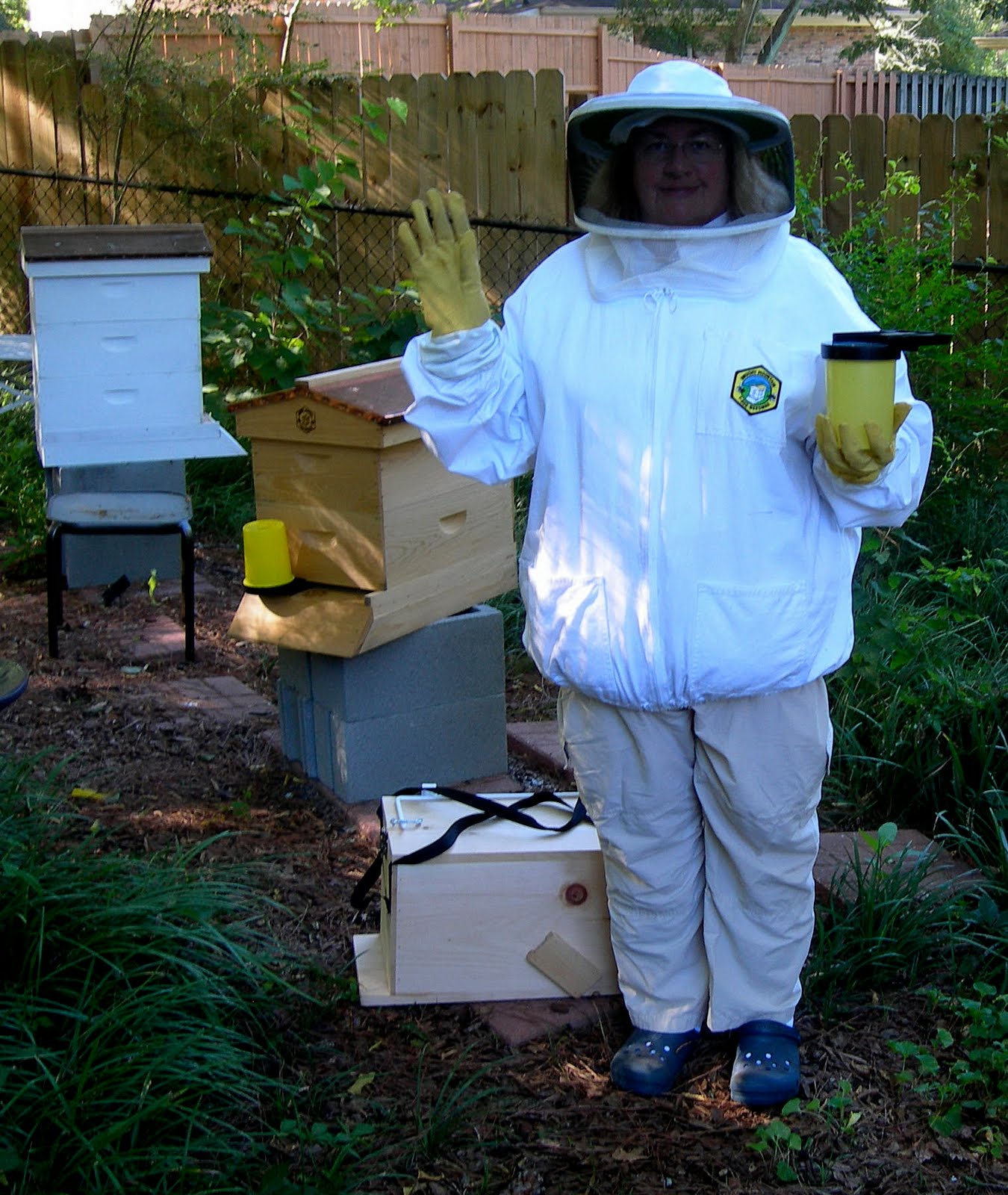
And now for something truly scary (could be this year's Halloween costume). My friend (and possibly biggest bee fan) Dick Funderburke has been nagging me about posting a photo of myself in my bee gear. So, here you go, Dick, this one's for you.

Yesterday's cool temps made doing a hive inspection more inviting. The top super of Apollo still shows little activity, except for a few bees drawing out comb and storing pollen. The middle super has brood and honey storage, and the bottom super is heavy with brood (see photo at right). When I say these supers are heavy, I mean it! I'm guessing they weigh at least 40 pounds each when full of bees and/or honey. I'm using medium-sized supers, so I can only imagine how heavy the deep supers must be when they are full.

I saw very few beetles in Apollo and found only a few in the beetle trap (pictured right). Forgot to pull out the sticky board to see if there were any moth larvae, but I'll do that next time. Thankfully, I'm not seeing any mites.
Rocky is still gaining strength. The bottom super has plenty of egg-laying activity going on, and the top super has some honey/sugar-water storage. After a discussion with my friend and bee-mentor Drea last week, I moved some empty frames to the center of the top super in hopes of encouraging the queen to move up and lay eggs there, too.
I've been curious about how the bees would react to cooler temperatures. The only real change I've noticed is a decrease in "bearding" on the outside of the hives. Guess it's more comfortable to be indoors these days.
Unfortunately, I've learned that bees really can sting through the protective clothing. I got a stinger through my glove. Sorry little buddy, you gave your life to zing one into the heel of my left hand. This makes only my fourth sting (not counting the rogue yellow yacket) of my beekeeping experience. I'd like to think this means my bees love me...but in reality I've just been lucky.

And now for something truly scary (could be this year's Halloween costume). My friend (and possibly biggest bee fan) Dick Funderburke has been nagging me about posting a photo of myself in my bee gear. So, here you go, Dick, this one's for you.
Labels:
beekeeping,
Halloween,
honey bees,
protective clothing,
small hive beetles,
sting,
supers
Wednesday, May 12, 2010
The beekeeping adventure begins


Monday, May 10, 2010 was the culmination of two years' worth of curiosity, research and deliberate intent to become a backyard beekeeper. I picked up my packaged bees — ordered from Rossman Apiaries in Moultrie, Ga. — at the post office, where a postal worker said, "Oh, thank GOD" when I told her why I was there. She brought out a plastic mail crate with the box of bees inside and handed it over. And thus, the real adventure began.
The "how-to" video that was included with the hive and bee supplies I'd ordered last year came in handy as I followed the instructions from memory on how to load a package of bees into the hive. I wore my veil, but found that gloves just got in the way. I didn't mind the soft feel of the little honeybees on my hands. They were confused and trying to figure out where their new home would be. I pulled out the cork in the queen's cage and placed her in the box, unceremoniously dumping the rest of the bees after her. They buzzed, but not in a bad way. I closed the hive, put in a feeder of sugar-water, and that was that.
For the past two days, the little winged creatures have been buzzing in and out of the hive just like they're supposed to. Thankfully, there weren't too many casualties along the way and they seem to be thriving. In fact, they are HUNGRY. Looks like I'll have to refill the feeder every day for the next several weeks.
No stings so far, and the dogs seem to have no interest in the bees. A very good thing.
Subscribe to:
Posts (Atom)