I left my hives alone for most of the summer, noting that they both were busy and humming. In September, I lifted the back of each hive. Both were almost too heavy for me to move, signaling they were full of bees and probably some honey. But what a difference a couple of months makes.
Today I went out to winterize the hives. With Atlanta's moderate climate, there isn't a lot of winterizing to do, unlike what beekeepers are tasked with in colder climates. Generally, I remove the extra supers from the top of a hive (those are usually empty), make sure the hive beetle trap is in place and doing its job, and insert an entrance reducer to cut down on the cold air flow.
Hive #2, which had not been named yet due to my superstition about waiting to be sure it's surviving, has been ravaged by wax moths. I won't document that in photos since I've shown it before, but suffice it to say that wax moths wreak a special, messy kind of havoc in a hive. There was a small cluster of honeybees left inside, but there is nothing I can do to save them. I took off two of the supers and then closed up the hive. On a warm winter day, I'll probably go out and dismantle everything. Most of that equipment will be unusable again.
On to Gloriana's Gold, which has a much happier, healthier story. The top super was empty, but clean. When I removed it, the super below began to hum and bees began moving up toward me to see what was going on. Good thing I'd checked the smoker and added some fuel before I started working on this one! This hive isn't exactly docile, but the smoke and the mid-50's temperature kept them quieter than usual.
The GG girls have been busy! They sealed off the hive beetle trap with propolis, so I removed it and made a mental note to order some more — as soon as they come, I'll install a fresh one. The bees have also made their own entrance reducer (see photo above) out of light-colored propolis! This is something I've never seen before, but have learned is common. Some bees just like to do their own winterizing.
Finally, the best news of all...Gloriana's Gold is chock full of honey in two supers. I'm debating whether to take out a few frames before the weather turns too cold for opening the hive. I may just leave it all in there for the girls to feed on until spring.
And yes, I will probably rebuild in the spring. After clearing out part of the side yard, there is more room and a level place for some hives, so I'm thinking of starting 2-3 more.
Showing posts with label honey bees. Show all posts
Saturday, December 3, 2016
Friday, September 13, 2013
Starving!
I was so thankful to receive dire warnings via Facebook and email from Metro Atlanta Beekeepers Association, as well as Brushy Mountain Beekeeping and Pigeon Mountain Trading Co. about the immediate need to feed the bees! Even though the season is deceptively warm and we're lured into thinking the bees have plenty of food, an actual lack of nectar flow has put Southern bees into starvation mode.
Yesterday I made a big batch of sugar syrup and went out to inspect Apollo, my only remaining hive. Sure enough, when I pulled off the inner cover, there was a cluster of about 100 dead bees on the top super. Sad, sad, sad. This super, which was full of honey a couple of months ago, was now almost devoid of honey. The bees were STARVING and had been feeding off their stores.
On the positive side, the queen had apparently made it up into this super and been hard at work laying eggs. Six of the frames were full of beautifully capped brood, eggs and larvae, and the laying pattern looked just as it should. My sweet little honeybees need a food source so that they can, in turn, nourish these baby bees and make a strong colony.
The girls went through a large plastic feeder of syrup yesterday and they are now working on a small feeder this morning. Probably time to think about ordering a feeder that can supply them for at least a few days at a time.
Hope I've dodged a bullet and kept Apollo going — I'd hate to lose yet another hive.
Wednesday, February 1, 2012
Sound detectives...
Here is an excellent article (complete with audio) about research being done on detecting the health of a hive by its sounds and sound levels. It also makes clear the importance and contributions of bees to agriculture, to the environment and to our world in general. (If an active link doesn't appear below, just copy and past the URL into the subject bar of your web browser.)
http://www.bbc.co.uk/news/technology-16114890
Sunday, October 23, 2011
Cleaning house!
There was not a lot happening with the hives in the past few weeks worthy of a post. However, now that the weather's turned cool, there are some interesting activities to report.
For the past week or so, I've noticed a few dead bees and white larvae at the entrance to each hive; mysteriously they vanished within a few hours. Since the numbers weren't large, I wasn't too alarmed (I knew the hives weren't being robbed) — but I did open my beekeeping books to do a little research. I learned that, since bees are very hygienic creatures, they take advantage of mild weather days to do some housekeeping. The girls drag dead bees and larvae out of the hive and then the bodies are carried away for disposal. Mystery solved.
This morning I did a quick inspection. Sweet Beezus has a few frames of honey along with a few frames of brood in the top super! When I harvest the honey in a few weeks, I'll take the frames that are honey-only and leave the brood frames. Way to go, first year bees!
Apollo also has some honey in the top super, but only on the frames in the center of the box. I'm a little surprised the Apollo girls haven't stored more, but then they had better things to do this spring and summer. They were busy, swarming more than once and then defending their hive against would-be robbers and other intruders like bumblebees and yellow jackets.
The Rocky girls were angry this morning when I opened their hive, so I was hopeful that meant they were protecting a supply of honey. No luck, though — bees are in the top super building out comb but nothing has been stored. Haven already given up their honey supply earlier this summer, they're probably holding a grudge against me!
There are small hive beetles present in all three hives, so on harvest day, I'll install some traps. It will also be time to reduce the hive entrances and put in some pollen patties for the girls to eat during the winter. I think the extra protein from the patties, along with installing the beetle traps and reducing the hive entrances to better keep out the cold air, helped keep my girls healthy last winter.
Labels:
bee hives,
beekeeping,
honey,
honey bees,
larvae,
small hive beetles
Sunday, June 26, 2011
Sweet BEEzus!
Friends and followers, you were all quite creative with the names you submitted for Hive #3, but I think pretty much everyone agreed that "Sweet BEEzus" was outstanding! Thank you, David. I'll be sending you the first jar of honey I harvest this summer.

Today's hive inspection was so exciting! First, Sweet BEEzus is queen right and thriving. A look into the top super showed the queen is laying in a nice pattern and the girls are storing honey/sugar syrup in the tops of the frames. In a couple of weeks when I stop feeding these girls, I'll add another super on top just in case they decide to make some honey.

Now, for Apollo. The original hive is going strong, despite producing a couple of swarms and some robbing activity. A peek into the third super shows the girls are storing honey on about three of the frames, but it is not yet capped. I'm hopeful they will make at least one super of honey by the end of the summer.

Rocky had the best suprise of all. My scrappy swarm hive captured last summer is very productive! This hive also swarmed twice in the spring and has fended off "robbers." When I pulled out some frames in the third super, they were heavy with honey, most of it capped! I'm pretty sure I'll be able to harvest this honey in a couple of weeks.
All of this honey activity sent me hurrying to my computer to order more supplies. I ordered two shallow supers with frames for more honey production in Apollo and Rocky; an escape screen for separating the bees from the honey super; and nylon strainer bags for the honey filtering system.
What a sweet morning it's been. I love my bees.
Wednesday, April 6, 2011
Swarmy weather
Today I experienced the natural phenomenon of swarming first-hand. I noticed some unusual activity going on in front of the Rocky hive this afternoon and when I went outside, I heard an enormous BUZZ. Thousands of bees were flying around in a frenzy in the warm sunshine, heading up to the branch of a nearby pine tree. They held in a tight cocoon on the branch, and I hoped that they would make their way to the empty hive I'd set out a few days ago.
About four hours later, the swarm had vanished, heading on to whatever permanent location they'd selected. Unfortunately, it wasn't the "bait" hive in my yard!
Here's a little movie of this afternoon's action:
About four hours later, the swarm had vanished, heading on to whatever permanent location they'd selected. Unfortunately, it wasn't the "bait" hive in my yard!
Here's a little movie of this afternoon's action:
Sunday, April 3, 2011
Preparation is the key

It's a beautiful, warm, sunny day — just perfect for painting my new hive and doing an inspection of Apollo and Rocky.
Both hives overwintered nicely and appear to be strong. I did not go into the bottom supers, but did pull some frames from the middle supers to see that the queen was busy laying eggs and the bees had plenty of honey stored around the edges for food.
I have put queen excluders on both hives and honey supers on top of those. (The excluder keeps the queen from making her way up and laying eggs in the honey super.) The workers have made their way up into the honey supers and are building out comb, so I hope this signals lots of sweet honey to come this summer!
Wednesday, November 24, 2010
Honey harvest!
In an earlier post, I whined (a little bit) about the probability of not getting any honey from my hives this first year. Well, this week, I reached that major milestone after all.
With colder weather approaching, it was time to prepare the hives for winter. Last weekend, I inserted an escape screen between the second and third supers in the Apollo hive in order to get the bees out of the top box. I wanted to remove the top box so that the bees would be forced down into just two supers and, therefore, stay warmer in a smaller space during cold weather.


The escape screen, by the way, is a simple but ingenious piece of equipment — bees can leave the honey super through the center hole of the screen, but cannot find their way back. No chemicals or fuming are involved in this method, and the bees stay calm. Normally, bees get very riled up if they think there's even a remote possibility that you're going to rob their honey stores.


While I was putting the escape screen in place, I noticed the bees had been a little more active in recent weeks and had actually stored some honey in the frames of the top super!
This morning, almost all of the bees had exited the honey super. The escape screen had worked like a charm! With Tim's help, I removed the honey super and then put protein patties (made mostly of pollen) into both hives for the bees to have as a winter food source. The hives were humming when I closed them, but it was more of a pleasant buzz than an angry one.
We brought the honey super into the garage, where I assembled a basic honey filtering system. The system consists of two five-gallon pails — the top pail has a fitted nylon mesh bag (similar to cheesecloth) and a sieve-like metal plate through which the honey is strained and then flows into the bottom pail. A spout attached to the bottom pail allows you to easily fill jars with honey.


Using an uncapping knife with a serrated edge, I sliced the cappings and wax off the frame inserts and let everything fall into the top pail of the filtering system. As the honey drips out of the cappings, it's filtered through the mesh bag and drains down into the bottom pail. Maybe tomorrow I'll have enough honey to fill a small jar or two!
The honey is a beautiful light amber color. I thought surely it would taste like clover since there's a lot of that in our neighborhood. However, it has a distinctly tangy, citrusy flavor. It's lovely.
Wednesday, September 22, 2010
Casualties are inevitable...

Latest inspection: both hives are actively producing new bees and storing honey and pollen for winter reserves. I got some honey on my frame grip as I reloaded frames into the supers — the bees wanted it back! See photo, right, of a few bees clustered on the grip.

Rocky is thriving, but bee-laden Apollo looks really healthy right now. I saw very few beetles and wax moth larvae, so I reckon the bees can, indeed, take care of themselves.
Opening up the hives is dicey process for the bees. Removing and replacing covers and supers inevitably results in some casualties...but I still feel bad about every bee I lose.
Monday, September 6, 2010
Cool breeze
We're experiencing our first taste of fall this weekend in north Georgia. We've got sunny, bright blue skies and a light breeze. The lows have been in the upper 50s/low 60s, with highs in the low-to-mid 80s and no humidity.

Yesterday's cool temps made doing a hive inspection more inviting. The top super of Apollo still shows little activity, except for a few bees drawing out comb and storing pollen. The middle super has brood and honey storage, and the bottom super is heavy with brood (see photo at right). When I say these supers are heavy, I mean it! I'm guessing they weigh at least 40 pounds each when full of bees and/or honey. I'm using medium-sized supers, so I can only imagine how heavy the deep supers must be when they are full.

I saw very few beetles in Apollo and found only a few in the beetle trap (pictured right). Forgot to pull out the sticky board to see if there were any moth larvae, but I'll do that next time. Thankfully, I'm not seeing any mites.
Rocky is still gaining strength. The bottom super has plenty of egg-laying activity going on, and the top super has some honey/sugar-water storage. After a discussion with my friend and bee-mentor Drea last week, I moved some empty frames to the center of the top super in hopes of encouraging the queen to move up and lay eggs there, too.
I've been curious about how the bees would react to cooler temperatures. The only real change I've noticed is a decrease in "bearding" on the outside of the hives. Guess it's more comfortable to be indoors these days.
Unfortunately, I've learned that bees really can sting through the protective clothing. I got a stinger through my glove. Sorry little buddy, you gave your life to zing one into the heel of my left hand. This makes only my fourth sting (not counting the rogue yellow yacket) of my beekeeping experience. I'd like to think this means my bees love me...but in reality I've just been lucky.

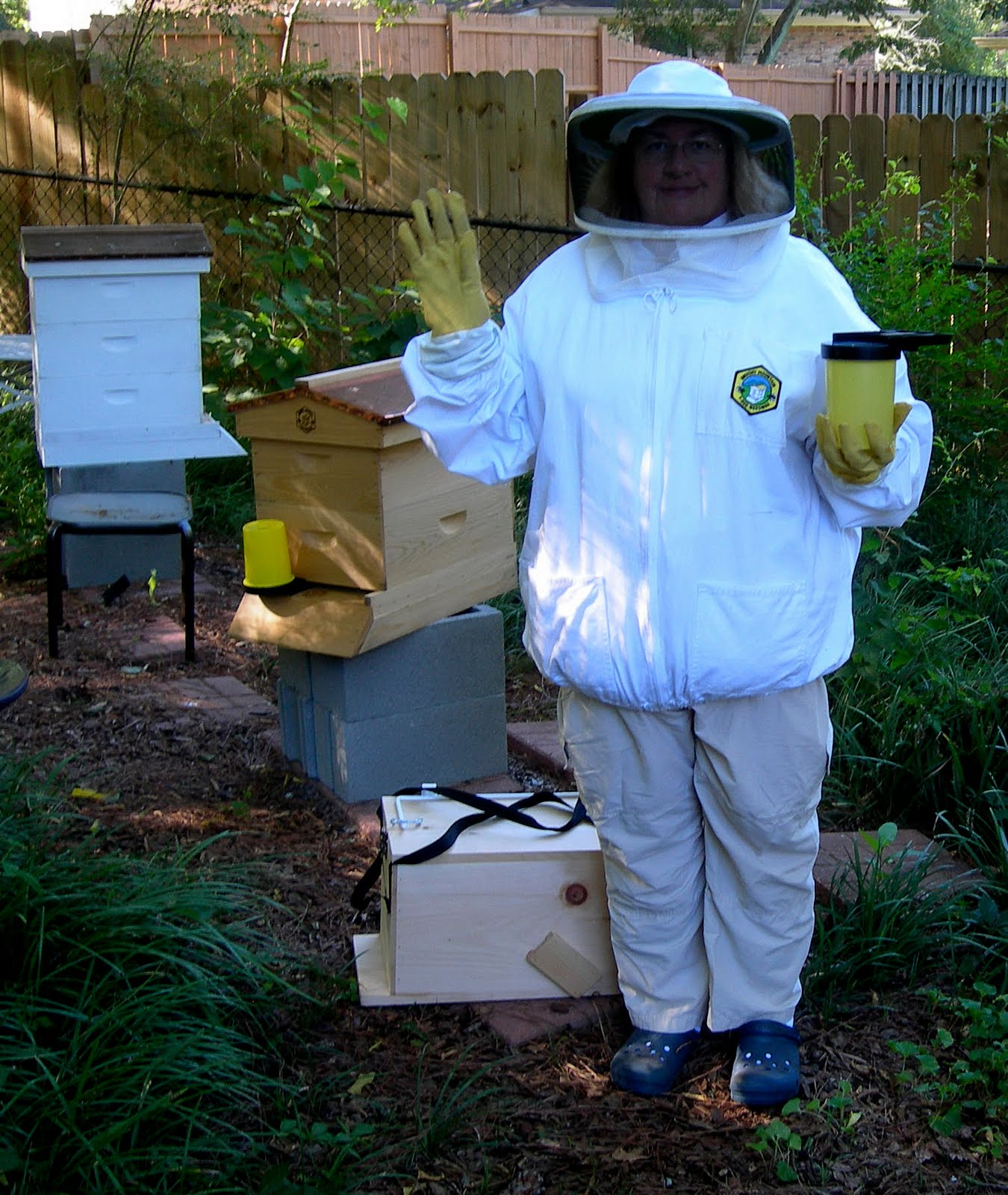
And now for something truly scary (could be this year's Halloween costume). My friend (and possibly biggest bee fan) Dick Funderburke has been nagging me about posting a photo of myself in my bee gear. So, here you go, Dick, this one's for you.
Labels:
beekeeping,
Halloween,
honey bees,
protective clothing,
small hive beetles,
sting,
supers
Monday, August 30, 2010
Up close and personal.
I love standing close enough to the hives to watch forager bees coming in for a landing, their back legs all loaded up with yellow and orange pollen. It's fascinating to watch as other bees rush to start cleaning the pollen off their sisters' legs as they enter the hive.
Yesterday I attempted to get some photos of the pollen-bearers, but failed. My camera just wasn't quite fast enough. I did, however, get a nice close-up of some of the Rocky bees.
And, drumroll, please... we have a winner in the "Please, For Goodness' Sake, Give Hive A a Name" contest. Hive A is now officially known as Apollo (submitted by Todd Gerlach). Thanks to everyone who submitted potential names! Should there be any more hives added to my bee yard, I reckon we'll continue on with the "Rocky" theme.
Yo, Adrian!
Yesterday I attempted to get some photos of the pollen-bearers, but failed. My camera just wasn't quite fast enough. I did, however, get a nice close-up of some of the Rocky bees.And, drumroll, please... we have a winner in the "Please, For Goodness' Sake, Give Hive A a Name" contest. Hive A is now officially known as Apollo (submitted by Todd Gerlach). Thanks to everyone who submitted potential names! Should there be any more hives added to my bee yard, I reckon we'll continue on with the "Rocky" theme.
Yo, Adrian!
Sunday, August 15, 2010
Guess it was inevitable.
This morning it was time to do another hive inspection. In my monthly email from Brushy Mountain, a new beekeeper blogs about her first-year experiences. She shared that she'd made the mistake of not inspecting the bottom super of her hive, assuming that if all looked well in the top supers, the bottom would be okay, too. Well, apparently all was not quite well. So I took her warning to heart and inspected my hives, top to bottom, today.
Rocky was first. Taking off the top super and setting it aside, I pulled some frames from the bottom super. What I saw scared me a bit — there was lots of sugar water being stored and capped, but I didn't see any capped brood, larvae or pupae. I put the second super back on top and pulled frames from it. There were the missing brood, larvae and pupae! When the swarm bees were in their temporary hive, I'd used a super with frames on top of the cardboard box. When I assembled the permanent hive, I made a mistake — this super, which obviously contains the queen, should have been on the bottom. I'll reverse the supers sometime over the next few days and hope that it corrects the "laying" problem.
Hive A (sorry folks, still haven't made a final decision on the name) presented an unpleasant surprise. When I removed the inner cover, I was dismayed to see a bunch of small hive beetles go running for cover. There are minimally invasive beetle traps available for this. Fill one halfway with vegetable or mineral oil and insert between two frames — the beetles are attracted to the trap and will fall into the oil. Simply clean out the trap periodically and replace it. I'll have to order these traps right away. There is very little activity in the top super other than a small amount of pollen storage so it's doubtful there will be any honey this year. The middle and bottom supers are being used for brood storage and food supply. Not much capped brood, but I did see some, plus some larvae. I'm going to hope for the best.
It's inevitable that every beekeeper will face some kind of infestation problem. Small hive beetles, mites (varroa and tracheal) and wax moths are the everyday evils that my hives will have to battle. There are a few worrisome diseases out there, too, but I'm hoping they're pretty rare for a back yard beekeepeer. I'm debating about whether to medicate my bees for mites or to try to find a more "organic" prevention method. As always, the experts are all over the map in their opinions on how to treat mites, so I'll probably end up flipping a coin.
Heads or tails?
Labels:
honey bees,
medicate,
mites,
small hive beetles,
traps
Tuesday, July 27, 2010
Flying high now...
At last, the swarm bees have a permanent home — the "Rocky" hive is up and running. I stayed home all day yesterday, anticipating the delivery of the new hive. By late afternoon, the UPS truck still hadn't come and I was very upset — storm clouds had gathered and the skies opened to pour down rain on the poor makeshift hive again. When 7 p.m. had come and gone, I called UPS to make a complaint, but I was told it was possible that my delivery could still come that evening. At 8:45, we heard the rumble of the delivery truck on our street, and it was a beautiful sound. I was glad to get the boxes and unpack them, even though it was too late to move the bees that night.
This morning, I assembled all of my gear, got the smoker going, suited up and headed out to the back yard to move the swarm bees. The bottom box of the makeshift hive had almost completely collapsed from yesterday's rain and was actually crumbling. Here's a photo of the sodden mess of cardboard, newspaper and empty feeder.
The plywood and bricks I'd used for a bottom board were still intact, but the board had bowed up after getting wet in this week's storms.I sprayed the bees down with a little sugar-water before trying to move them, but they were in a fairly calm state anyway. It was easy to move the three frames I'd put in the cardboard box to a regular super. I was excited to see that the bees had built out a lot of comb on these frames. I added in the remaining five frames to the box and then moved the second super on top. The bees had moved up into this second box on the temporary hive and were storing pollen in its frames. I placed the inner cover on top of the second super, closed it up with the cover and inserted a full feeder.

Here, you can see the Rocky bees at the entrance to their new home. I wish I'd had time to paint this hive, but it's all made of cypress and I'm told that it will endure all kinds of weather for years. The main worries now are whether or not the queen made it into the hive (again, I didn't see her) and robbing by the original hive bees. Speaking of the original hive, I'm looking for a name for it. Any suggestions?
Sunday, July 25, 2010
A (bee) house of horrors

Those poor swarm bees. The thunderstorms and downpours of the last two days have done their damage to the makeshift hive. The plywood base and roof bowed up and the cardboard box is in a state of collapse (giving new meaning to the term, "colony collapse disorder"). I was able to replace the roof with another piece of plywood, but there is not much I can do about the base or the box. I did remove some of the newspaper plugs from a couple of corners of the hive so the poor bees could have some air and a way in and out. I can only imagine how it looks inside.
Still, when I went out to replace the feeder this morning, they were hanging in there. I was thinking of giving each hive a name. The swarm bees, being the underdogs with a fighting spirit, are definitely "Rocky."
I tracked the status of the hive I ordered and it made it to the Atlanta area Friday and was scanned for Monday delivery. It can't come soon enough. Hang in there, little winged friends, help is on the way!
Really, I couldn't blame them if they swarmed again and left for good, considering their current living conditions. I just hope their temporary house of horrors doesn't turn into the (bees)wax museum.
Thursday, July 22, 2010
Swarm alert!
Today I had the most amazing experience — I collected my first swarm! It all started when our backyard neighbor, Oscar, came over this morning to tell me that my bees had swarmed in his yard, specifically on his patio table umbrella. I met him at the fence, peered over, and sure enough, there was a large swarm attached to the umbrella.
For a moment, I panicked. I'm a novice beekeeper with only one hive, for pete's sake. I knew what a swarm was, but had no idea how to go about collecting one. There wasn't much time until the swarm would decide to move on, so I pulled myself together and thought about who to call. I remembered that my friend Cookie and I had discussed bees a few months ago and she mentioned that she knew beekeeping guru Cindy Bee. (Yes, that is actually her name and it is certainly appropriate!) Cookie had emailed Cindy Bee's contact information to me. I found the email and quickly dialed Cindy, who took time out of her busy schedule to give me some quick pointers over the phone.
Since I don't have a second hive box yet, I would have to assemble a makeshift hive from whatever we had on hand in the garage. First, Cindy advised me to use plywood and 2x4's to make a bottom board. I had sheets of plywood, but not 2x4s, so I used bricks. Next, I was to take a cardboard box and cut a small horseshoe-shaped hole in the bottom to make a flap that would open for the bees to enter and exit. Then Cindy said I should spray a small amount of lemon-scented Pledge or lemon juice around the opening, which would help attract the bees. I had two extra supers on hand, so I removed some of the frames from one super and put them in the cardboard box, as instructed.
It was time to suit up and head over to Oscar's yard to collect the swarm. Using my bee brush, I brushed the bees (thousands of them) downward from the umbrella into the box. They seemed happy to land in the lemon-scented box and quickly crawled onto the frames. I set the open box on the patio table for a while and the remaining bees that were flying around eventually headed into the box. I'd say I collected about 99% of the swarm before I put a lid on the box and took the bees back to my yard.
Then came the hard part. I set the box on the makeshift landing board and pulled the flap open from underneath to give the bees an entrance and exit. Next, I put a super with frames on top of the cardboard box. Per Cindy's instructions, the bees needed to be fed with the 1:1 sugar/water solution, so that required some ingenuity on my part. I had a mason jar on hand, but no ice pick with which to poke small holes in the top — I ended up using a seam-ripper from my sewing kit to make the perfect little bee-sized drinking holes in the top of the jar. I took the jar, filled with sugar-water, and my last unused super (empty, no frames) out to the makeshift hive. This top super would protect the feeding jar, which I turned upside down on top of the frames in the super below. I covered the whole thing with another piece of plywood.
To sum up the configuration from the bottom up: plywood bottom board, bricks, cardboard box with bees, super with frames, feeder jar inside empty super, plywood cover. It's a little sad-looking, but I hope it will do the job temporarily.

A quick peek under the plywood cover showed that the swarm bees had already found the sugar-water. Cindy warned that my original hive would be very interested in this new, weaker hive and its sugar-water supply and might try to "rob" it. She cautioned me to find and seal all of the openings, leaving only one space of about an inch or so for the swarm bees to enter and exit their hive. This would give them a better chance of protecting their hive and sugar-water supply from intruders. Since the cardboard box was sagging in places and there were odd-shaped openings all around, I decided to use newspaper to stuff the holes. It remains to be seen if this method is successful — every time I checked the hive this afternoon I saw the crafty little winged creatures entering and exiting new places, so I had to plug those with paper. May have to pull out the duct tape soon.
I also needed to check the original hive and see what was going on, Cindy advised. I took off the cover and saw that the boxes were full of bees. No beetles in sight. That's a good sign, she said. I hope this means that the bees swarmed because the original hive was too congested — they split to form a new colony.
I called Brushy Mountain Bee Company and ordered a hive right away. The cost to ship it to me overnight was prohibitive. Wendy reassured me they would ship my order out today, so I opted for regular shipping. I'll probably get my order on Monday, but if I'm lucky, it could come sooner. Then I'll set up the new hive in a permanent location and move the swarm bees from their makeshift home. That's assuming they survive the weekend, the other hive doesn't decide to "rob" them, and they don't decide to swarm again and go somewhere else.
I'm grateful for the generosity of neighbors, friends and an expert who doesn't know me from Adam's house cat. What an exciting and rewarding experience.
Sunday, July 18, 2010
My hive grew a beard.
For the past few weeks, my bees have been hanging out on the exterior of the hive and the landing board. I was afraid this meant they were preparing to swarm, but actually, they are doing something called "bearding."
Bearding is a phenomenon that happens during warm, humid weather — usually in the mid-to-late summer (swarming is most likely to occur in the spring). The bees are just plain hot and some of them go outside the hive in order to give added ventilation to the house bees and brood nest inside. When they cluster on the exterior this way, it gives the hive the appearance of having a beard.
Honey bees are so smart.
Bearding is a phenomenon that happens during warm, humid weather — usually in the mid-to-late summer (swarming is most likely to occur in the spring). The bees are just plain hot and some of them go outside the hive in order to give added ventilation to the house bees and brood nest inside. When they cluster on the exterior this way, it gives the hive the appearance of having a beard.Honey bees are so smart.
Saturday, June 12, 2010
I hate yellow jackets.

I hate yellow jackets. Of course I do. I grew up in a Georgia family, immersed in all things UGA. My mother's family is actually full of Georgia Tech grads and one of my best friends is a Tech grad, and I must say they are all wonderful folks...but they instill no love in me for the yellow jacket.
Now I have a reason to hate the varmints even more. Thursday morning, I went out to the hive to feed the bees. Smoker in hand, all went well until I pulled out the empty feeder and...noticed a rogue yellow jacket in the midst of my sweet honey bees. (Aren't the bees supposed to get rid of nasty intruders? Guess they hadn't had a chance yet.) Smoke works well on honey bees, but not on yellow jackets. Smoke makes yellow jackets mad... not that they need much encouragement.
The yellow jacket made a beeline (ha ha) for my leg and stung me. Repeatedly. By the time I disengaged him from my pants leg and hobbled into the house, I could tell this was no ordinary sting. I applied some anti-sting stuff and hoped for the best. I barely slept that night.
By Friday morning the side of my thigh, from hip to knee, was red, swollen and firm to the touch. It looked similar to the bad reaction I had a few years ago when a jellyfish wrapped its tentacles around both my arms in the ocean at St. Simons. I called my doctor's office and she was able to work me in that afternoon. "Ohhhhh, that doesn't look so good," were the first words out of her mouth. I got a shot of prednisone and left with three prescriptions for other medicines to cure me of the evil jellow jacket venom.
So, just a reminder. Honey bees are defensive creatures — they only attack when they perceive their hive is under siege from an outsider. They respond well to smoke. Other winged insects not so much. Yellow jackets, along with hornets and wasps, are aggressive and will sting with very little provocation.
Oh, and Mom? Glad you turned away from the dark side. You chose well. Dawgs are good; jackets are BAD.
Labels:
Georgia Tech,
honey bees,
jellyfish,
prednisone,
UGA,
yellow jackets
Tuesday, June 8, 2010
Bee movie
Today, I made a little film of the bees in action. If you'd like to hear my silly narrative, turn your sound on. Otherwise, just enjoy the bees at work.
Thursday, June 3, 2010
Bees as icebreaker
Over the years I've learned there are several topics that make for great conversation starters in just about any given situation. For example, if you like sports, you will likely find a group of similar-minded folks at almost every social gathering and the talk comes easy. (College football is a popular topic as evidenced by the number of people who crowd around an available TV or Blackberry in the fall, looking for score updates while they attend wedding receptions, parties, business conventions and their kids' soccer games.)

If you're an instigator (like me) of "spirited" conversation, grits is a particularly polarizing subject that gets people going. Most Southerners love grits and most Yankees hate grits, and neither side will give an inch. Well, except for the occasional northern aggressor who admits to eating grits...with sugar on top. Ew! Bless their hearts, they just don't know any better. Besides, their relatives and friends will pull their Yankee card when they go back north to visit and admit they eat grits.
Okay, back to the original point — getting a good conversation going. I've found that bees are a great icebreaker. Recently, I've mentioned my bees at a wedding reception, at the gym, in a business meeting and to the nice lady who cuts my hair, among others. Reactions range from "I've read about the honey bees disappearing," and "Cool! When can I have some honey?" to "Isn't that illegal?" and (courtesy of Greg) "HAVE YOU LOST YOUR MIND?!"
In any case, people are mostly fascinated by bees, even if some are repulsed. They pepper me with questions, information they've heard on the news, memories of relatives who kept bees and tales of bad childhood encounters with bees. No one seems disinterested or even neutral.
Bees are a topic that really creates a buzz!
Labels:
college football,
grits,
honey bees,
Southerners,
Yankees
Saturday, May 29, 2010
What could go wrong?
Thursday night I tuned in to a webinar offered by Brushy Mountain Bee Farm, from which I've bought most of my beekeeping supplies. If anyone out there is interested in becoming a backyard beekeeper or just wants to learn more about beekeeping in general, Brushy Mountain is a great resource: www.brushymountainbeefarm.com.
The guest speaker for the webinar was Jennifer Berry, Apicultural Research Coordinator and Lab Manager at the University of Georgia. UGA has an excellent honey bee program in its Entomology department. (GO DAWGS 'n BEES!) Jennifer has done extensive research on almost everything that can go wrong (or right) with honeybees — from pests to genetics. I learned a lot — particularly that I should have started with two hives rather than one. Two hives would afford me some means of comparison. And if one hive seemed weak, I could equalize the two hives by adding brood or bees from the stronger to the weaker. There was also some scary info about pests, diseases and unfertilized queens who only lay drone eggs.
I logged off the webinar when I felt I'd absorbed as much bad news as I could take. And after thinking it over, I'm feeling philosophical today. If my bees don't make it this year, I'll certainly be better informed and prepared for what to do next year. In the meantime, I'll think positive. My bees seem pretty darned scrappy right now.
My mother and brother came over today to visit, meet Katie Scarlett, and see the bees. I wish I'd remembered to take along my camera so I could make some shots of the two of them tricked out in bee gear! We smoked and fed the bees, then opened the hive to observe them. Looks like the bees are working on all eight frames of the bottom box and are on all but two in the second box. They are drawing out comb and we could see lots of pollen in the cells. All appears well, at least to my inexperienced eyes.
As if all this weren't enough, Mom took us to Dreamland for a lunch of barbecue and iced tea. "Ain't nothing like 'em, nowhere!" as their slogan says.
An excellent day, all in all. So why worry about what could go wrong? Since I'm still in Scarlett O'Hara mode, I'll think about it tomorrow. After all, tomorrow is another day.
The guest speaker for the webinar was Jennifer Berry, Apicultural Research Coordinator and Lab Manager at the University of Georgia. UGA has an excellent honey bee program in its Entomology department. (GO DAWGS 'n BEES!) Jennifer has done extensive research on almost everything that can go wrong (or right) with honeybees — from pests to genetics. I learned a lot — particularly that I should have started with two hives rather than one. Two hives would afford me some means of comparison. And if one hive seemed weak, I could equalize the two hives by adding brood or bees from the stronger to the weaker. There was also some scary info about pests, diseases and unfertilized queens who only lay drone eggs.I logged off the webinar when I felt I'd absorbed as much bad news as I could take. And after thinking it over, I'm feeling philosophical today. If my bees don't make it this year, I'll certainly be better informed and prepared for what to do next year. In the meantime, I'll think positive. My bees seem pretty darned scrappy right now.
My mother and brother came over today to visit, meet Katie Scarlett, and see the bees. I wish I'd remembered to take along my camera so I could make some shots of the two of them tricked out in bee gear! We smoked and fed the bees, then opened the hive to observe them. Looks like the bees are working on all eight frames of the bottom box and are on all but two in the second box. They are drawing out comb and we could see lots of pollen in the cells. All appears well, at least to my inexperienced eyes.
As if all this weren't enough, Mom took us to Dreamland for a lunch of barbecue and iced tea. "Ain't nothing like 'em, nowhere!" as their slogan says.
An excellent day, all in all. So why worry about what could go wrong? Since I'm still in Scarlett O'Hara mode, I'll think about it tomorrow. After all, tomorrow is another day.
Labels:
barbecue,
drones,
honey bees,
queens,
Scarlett O'Hara,
University of Georgia
Subscribe to:
Posts (Atom)