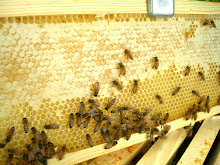
Since Apollo is my only surviving hive at the moment and its residents have been through a lot already this year, I can only send up a prayer on little honeybee wings that these girls will make some honey to spare this summer.
This morning I installed a beetle trap and put on a queen excluder and two shallow honey supers. The inner cover had deteriorated over the past three years (assisted by the wax moth infestation a few months ago), so I replaced it. While I waited for the smoker to do its job and the bees to calm down and retreat, I peered down into the top brood super -- nice to see it was chock full of bees and they were storing some honey around the edges of the frames.
I removed Rocky from its perch and will break it down and bag it for trash. While there is evidence that the hive had wax moths, I can't help but believe there were other problems that contributed to its demise, including hive beetles, mites and maybe too much moisture.
Sweet Beezus is ready and waiting for new occupants. I can't find my receipt from Rossman Apiaries, but if I recall correctly, my package bees will ship out sometime next week or the following week. Maybe the second time around will be the charm for this hive.
Saturday, May 11, 2013


Thursday, March 7, 2013
A Tale of Two Hives
This has been a challenging winter for both hives. I've learned more about the pests that plague honeybees and about the value of regular hive inspections, winter feeding and "re-queening." Let's just say I've learned these lessons the hard way.
Apollo
Apollo is my original hive, which I started with a package back in May 2010. This hive has overcome numerous problems including multiple swarms, one particularly brutal and prolonged cold snap and several different pests.
A couple of months ago, I pulled off the cover and noticed that there was a white substance underneath the inner cover. It looked like expandable foam sealant, actually. I had a very hard time prying the inner cover off the top super, and when I finally did, was horrified to see a thick layer of white cocoons. Apollo had a wax moth infestation. (Click on the photo below if you'd like to see an enlarged image.)

Wax moths are extremely destructive insects, spinning webs throughout the hive and their larvae destroying not only the brood comb but also the hive equipment. Here is a picture of the damage done to the super and frames by larvae burrowing into the wood.

I removed the top super — which could not be salvaged — and cleaned out as much webbing and other wax moth debris as I could, put in some fondant for the bees to feed on, closed the cover and hoped for the best. Although I've been told that honeybees are likely to abscond from a wax moth-infested hive, the Apollo bees chose to stay and, miraculously, appear to be thriving right now.
Recently I attended a lecture given by honeybee expert Dr. Keith Delaplane about colony collapse disorder and what the disappearance of honeybees and other pollinators means to the environment and to our way of life. (Check out this informative editorial, "On Einstein, Bees, and Survival of the Human Race.")
Afterward, I was able to ask Dr. D. about my wax moth issue and he just smiled and said, "Wax moths are generally only a symptom of a bigger problem. If the hive is healthy and the bees are robust, they can fend off wax moths pretty easily." So, we talked about the probability of Varroa mites (at least the small hive beetles are under control, I'm glad to say), or... an unhealthy or dead queen. He suggested I "re-queen" the hive, which involves killing the old queen and introducing a new, healthy queen. I shuddered visibly, I guess, because Dr. D. simply smiled again and wished me luck.
For now, I'm watching and waiting to see if Apollo has the strength to keep on keepin' on. There are hundreds of girls out and about lately, flying around in the sunshine on these warm afternoons, so I'm thinking they're gonna make it.
Rocky
Sadly, today I discovered that the Rocky hive is dead. I'd suspected as much because there have been so few bees visibly out and about, nowhere near as many as Apollo. I'm sad and feeling like a "bad mom" because if I'd paid more attention sooner, I might have been able to salvage the situation. I could've re-queened this hive and fed the bees with not only fondant, but also pollen patties.
Bees need a food source during the winter, even in Atlanta where there is some pollen available for foraging pretty much year-round. This year, I didn't give them pollen patties and I feel like this was part of the reason for hive failure.
So, I fell down on the job and it's a hard lesson learned again after losing the Sweet Beezus hive last winter.
Plan B
I've got a package of bees on order to repopulate Sweet B, and those bees will arrive in May. In the meantime, I've signed up to attend a hive inspection tour offered by the Metro Atlanta Beekeepers Association in a few weeks. The inspection of multiple hives will be conducted by a master beekeeper and we'll be able to observe and learn what to look for in determining whether the hive is healthy or has problems.
Also, I found out that, as a MABA member, I can put my name on the "swarm list" and possibly be the recipient of a swarm of bees that MABA beekeepers are routinely called on to collect from people's yards, businesses, school playgrounds, etc. As often as my own Apollo bees have swarmed in the past, I might be lucky enough to collect my own swarm again this spring and repopulate the Rocky hive. And that's an interesting idea in itself, because Rocky was started from an Apollo swarm the first year I began beekeeping.
Apollo
Apollo is my original hive, which I started with a package back in May 2010. This hive has overcome numerous problems including multiple swarms, one particularly brutal and prolonged cold snap and several different pests.
A couple of months ago, I pulled off the cover and noticed that there was a white substance underneath the inner cover. It looked like expandable foam sealant, actually. I had a very hard time prying the inner cover off the top super, and when I finally did, was horrified to see a thick layer of white cocoons. Apollo had a wax moth infestation. (Click on the photo below if you'd like to see an enlarged image.)

Wax moths are extremely destructive insects, spinning webs throughout the hive and their larvae destroying not only the brood comb but also the hive equipment. Here is a picture of the damage done to the super and frames by larvae burrowing into the wood.

I removed the top super — which could not be salvaged — and cleaned out as much webbing and other wax moth debris as I could, put in some fondant for the bees to feed on, closed the cover and hoped for the best. Although I've been told that honeybees are likely to abscond from a wax moth-infested hive, the Apollo bees chose to stay and, miraculously, appear to be thriving right now.
Recently I attended a lecture given by honeybee expert Dr. Keith Delaplane about colony collapse disorder and what the disappearance of honeybees and other pollinators means to the environment and to our way of life. (Check out this informative editorial, "On Einstein, Bees, and Survival of the Human Race.")
Afterward, I was able to ask Dr. D. about my wax moth issue and he just smiled and said, "Wax moths are generally only a symptom of a bigger problem. If the hive is healthy and the bees are robust, they can fend off wax moths pretty easily." So, we talked about the probability of Varroa mites (at least the small hive beetles are under control, I'm glad to say), or... an unhealthy or dead queen. He suggested I "re-queen" the hive, which involves killing the old queen and introducing a new, healthy queen. I shuddered visibly, I guess, because Dr. D. simply smiled again and wished me luck.
For now, I'm watching and waiting to see if Apollo has the strength to keep on keepin' on. There are hundreds of girls out and about lately, flying around in the sunshine on these warm afternoons, so I'm thinking they're gonna make it.
Rocky
Sadly, today I discovered that the Rocky hive is dead. I'd suspected as much because there have been so few bees visibly out and about, nowhere near as many as Apollo. I'm sad and feeling like a "bad mom" because if I'd paid more attention sooner, I might have been able to salvage the situation. I could've re-queened this hive and fed the bees with not only fondant, but also pollen patties.
Bees need a food source during the winter, even in Atlanta where there is some pollen available for foraging pretty much year-round. This year, I didn't give them pollen patties and I feel like this was part of the reason for hive failure.
So, I fell down on the job and it's a hard lesson learned again after losing the Sweet Beezus hive last winter.
Plan B
I've got a package of bees on order to repopulate Sweet B, and those bees will arrive in May. In the meantime, I've signed up to attend a hive inspection tour offered by the Metro Atlanta Beekeepers Association in a few weeks. The inspection of multiple hives will be conducted by a master beekeeper and we'll be able to observe and learn what to look for in determining whether the hive is healthy or has problems.
Also, I found out that, as a MABA member, I can put my name on the "swarm list" and possibly be the recipient of a swarm of bees that MABA beekeepers are routinely called on to collect from people's yards, businesses, school playgrounds, etc. As often as my own Apollo bees have swarmed in the past, I might be lucky enough to collect my own swarm again this spring and repopulate the Rocky hive. And that's an interesting idea in itself, because Rocky was started from an Apollo swarm the first year I began beekeeping.
Thursday, January 3, 2013
Happy 2013!
I can't believe it's been 6 months since I posted anything about bees. Shame on me!
Winterizing time:
This year, I remembered my lesson about leaving some honey in the hives for the bees to feed on during the cold months — both Apollo and Rocky have a box of frames nearly filled with honey. I'm also planning to make fondant and put that in the hives as an extra food source. When colder temps arrived in north Georgia a couple of months ago, I went ahead and inserted entrance reducers to keep some of the cold wind out, but I also made sure the outer covers are pulled forward to allow for some ventilation.
I haven't opened the hives in several weeks, so I must do that soon and "bee" sure everything is okay. Perhaps this weekend will bring a rain-free day just right for a hive check.
Repopulating Sweet Beezus:
A new package of bees is on order to be delivered in May, so Sweet Beezus will have occupants once again. In the meantime, I need to move this hive to a more hospitable location...probably closer to Apollo and Rocky, which have both had pretty good success.
This spring will mark the beginning of my fourth year of beekeeping. It seems like only a few weeks have passed since that first package of bees arrived in 2010. And oh, what an adventure and fabulous learning experience it's been ever since!
Winterizing time:
This year, I remembered my lesson about leaving some honey in the hives for the bees to feed on during the cold months — both Apollo and Rocky have a box of frames nearly filled with honey. I'm also planning to make fondant and put that in the hives as an extra food source. When colder temps arrived in north Georgia a couple of months ago, I went ahead and inserted entrance reducers to keep some of the cold wind out, but I also made sure the outer covers are pulled forward to allow for some ventilation.
I haven't opened the hives in several weeks, so I must do that soon and "bee" sure everything is okay. Perhaps this weekend will bring a rain-free day just right for a hive check.
Repopulating Sweet Beezus:
A new package of bees is on order to be delivered in May, so Sweet Beezus will have occupants once again. In the meantime, I need to move this hive to a more hospitable location...probably closer to Apollo and Rocky, which have both had pretty good success.
This spring will mark the beginning of my fourth year of beekeeping. It seems like only a few weeks have passed since that first package of bees arrived in 2010. And oh, what an adventure and fabulous learning experience it's been ever since!
Thursday, June 7, 2012
Shallow honey
Today is a relatively cool day for June with temps in the 70s, so it's a good day to harvest more honey. I took the top super off Apollo and found all 8 frames were filled with honey, so I removed them. This is a shallow super and I was pleased to see that the honey is a light amber, plus most of the frames were dry capped. They look "cleaner" than some previous frames that had multi-colored pollen stores as well as honey.
When I scrape the wax cappings off these frames, I'm hoping to be able to wash and melt them down to use as a side product — perhaps candles or hand cream. So there is my winter project!
When I scrape the wax cappings off these frames, I'm hoping to be able to wash and melt them down to use as a side product — perhaps candles or hand cream. So there is my winter project!
Tuesday, May 29, 2012
Why Sweet B is inhospitable and more...
My goodness, how time flies! It's been two months since I last posted and there's a lot to catch up on here.
First, several people have asked if there are bees in Sweet Beezus. The current answer is no. I decided against ordering another package of bees this year, instead hoping to attract a swarm. A few weeks ago, there was a buzz inside Sweet B one afternoon and it appeared a swarm had taken up residency. By the next day, however, the bees had moved on.
Today I noticed a lot of frantic activity in front of the Rocky hive, so I went out to prepare Sweet Beezus in case the activity turned out to be another swarm. When I opened Sweet B, I saw some icky, scary stuff: there was evidence of wax moths, a couple of roaches and a whole colony of earwigs. I started taking the hive apart, removing the frames that had wax moth webs, knocking the earwigs and roaches out...and then I turned over the bottom board to brush off some spider egg cocoons. Fortunately I spotted the round black spider before my fingers reached it — it was a black widow! YIKES! Talk about inhospitable for new bees!
I cleaned up Sweet B as best I could, put in some clean frames and added some "bee lure," a pheromone that is supposed to attract bees. Perhaps now it will be more inviting.
Second, I harvested my first batch of honey for the year a couple of weeks ago. I took only five frames each out of Apollo and Rocky, and spent half a day crushing, straining and filtering the honey. Those 10 frames (from medium supers) yielded about 30 pounds of honey. I left three half-finished frames in each super and replaced the ones I took out with empty frames. Also, I moved the shallow honey supers to the top of each hive and was excited to see those were almost full of capped honey, too!
 So, with this banner crop of honey, I decided it was time to sell it. I ordered 8-ounce squeeze bottles with flip-caps and a roll of labels from Brushy Mountain. This weekend, I filled 40 bottles to sell and began getting the word out to friends and acquaintances. So far, 10 bottles are gone with orders coming in for more. Very exciting!
First, several people have asked if there are bees in Sweet Beezus. The current answer is no. I decided against ordering another package of bees this year, instead hoping to attract a swarm. A few weeks ago, there was a buzz inside Sweet B one afternoon and it appeared a swarm had taken up residency. By the next day, however, the bees had moved on.
Today I noticed a lot of frantic activity in front of the Rocky hive, so I went out to prepare Sweet Beezus in case the activity turned out to be another swarm. When I opened Sweet B, I saw some icky, scary stuff: there was evidence of wax moths, a couple of roaches and a whole colony of earwigs. I started taking the hive apart, removing the frames that had wax moth webs, knocking the earwigs and roaches out...and then I turned over the bottom board to brush off some spider egg cocoons. Fortunately I spotted the round black spider before my fingers reached it — it was a black widow! YIKES! Talk about inhospitable for new bees!
I cleaned up Sweet B as best I could, put in some clean frames and added some "bee lure," a pheromone that is supposed to attract bees. Perhaps now it will be more inviting.
Second, I harvested my first batch of honey for the year a couple of weeks ago. I took only five frames each out of Apollo and Rocky, and spent half a day crushing, straining and filtering the honey. Those 10 frames (from medium supers) yielded about 30 pounds of honey. I left three half-finished frames in each super and replaced the ones I took out with empty frames. Also, I moved the shallow honey supers to the top of each hive and was excited to see those were almost full of capped honey, too!

Sunday, March 25, 2012
There's a lot going on in the bee world right now.
The unusually warm temperatures for this time of year have generated a lot of early activity among honeybees in many parts of the country. Here in Atlanta, trees and flowers bloomed early, the pollen count has reached extreme levels, and swarming began in late February.
My Apollo bees swarmed a couple of weeks ago. They "buzz level" was audible for a few days beforehand and bearding happened the day before. The swarm made its way to the pine tree limb in my neighbor's yard, a popular spot for last year's swarms. Later that same day, the bees came back down into my yard and clustered near the ground on some scrub shrubbery. My attempt to collect them from the ground failed miserably (including taking a couple of stings to my right leg). The next afternoon, the bees were back up in the pine tree and later took off for parts unknown.
I have since learned how to collect a swarm from the ground via a YouTube video and some words of wisdom from Jerry Wallace of the Metro Atlanta Beekeepers. In a couple of weeks, my friend Drea and I are driving up to Lafayette, Ga. to visit Pigeon Mountain Trading Company, which has quite a cache of beekeeping supplies. I plan on buying a swarm trap and some bee lure (pheromone) to see if I can attract some bees to fill my empty Sweet Beezuz hive.
This morning's inspection was really interesting, probably generating more questions than answers. First, the Rocky hive: I removed the top shallow super when I saw that the wax inserts were all coming out of their frames. It would be almost impossible for the bees to shore them up enough to store honey. I'll fix them and put the box back on next time. A look into the next super showed that the Rocky girls are busily making honey there — no sign of laying activity, so I hope to harvest this box in a couple of months. I pulled out the sticky board from below and saw something interesting — a bunch of dark "pods." I can't tell if these are just propolis or if the bees have entombed some kind of insect. I set the board aside to look at later.
Now, the Apollo hive: there were bees in the top shallow super and the frames there were in good shape. But when I went down into the next box, I got a little shock. The Apollo girls are storing honey around the edges of the frames, but there were a LOT of supersedure cells (emergency queen cells) on the middles frames. Does this mean the hive is without a queen or is it just an indication of a lot of future swarm activity? So there's my homework. When I pulled out the sticky board, dozens of earwigs came with it. Ugh. I am leaving these boards out of the hives for now — most insects that the bees can't take care of themselves will fall onto the screened bottom board and not cause problems.
I removed the plastic feeders from the entrance of both hives. I found wax moth larvae at the Apollo hive entrance, which I quickly destroyed. The beetle traps seem to be working well in both hives. Next time, I must remember to take the camera and document with photos!
Here's a video of my first swarm of the season.
My Apollo bees swarmed a couple of weeks ago. They "buzz level" was audible for a few days beforehand and bearding happened the day before. The swarm made its way to the pine tree limb in my neighbor's yard, a popular spot for last year's swarms. Later that same day, the bees came back down into my yard and clustered near the ground on some scrub shrubbery. My attempt to collect them from the ground failed miserably (including taking a couple of stings to my right leg). The next afternoon, the bees were back up in the pine tree and later took off for parts unknown.
I have since learned how to collect a swarm from the ground via a YouTube video and some words of wisdom from Jerry Wallace of the Metro Atlanta Beekeepers. In a couple of weeks, my friend Drea and I are driving up to Lafayette, Ga. to visit Pigeon Mountain Trading Company, which has quite a cache of beekeeping supplies. I plan on buying a swarm trap and some bee lure (pheromone) to see if I can attract some bees to fill my empty Sweet Beezuz hive.
This morning's inspection was really interesting, probably generating more questions than answers. First, the Rocky hive: I removed the top shallow super when I saw that the wax inserts were all coming out of their frames. It would be almost impossible for the bees to shore them up enough to store honey. I'll fix them and put the box back on next time. A look into the next super showed that the Rocky girls are busily making honey there — no sign of laying activity, so I hope to harvest this box in a couple of months. I pulled out the sticky board from below and saw something interesting — a bunch of dark "pods." I can't tell if these are just propolis or if the bees have entombed some kind of insect. I set the board aside to look at later.
Now, the Apollo hive: there were bees in the top shallow super and the frames there were in good shape. But when I went down into the next box, I got a little shock. The Apollo girls are storing honey around the edges of the frames, but there were a LOT of supersedure cells (emergency queen cells) on the middles frames. Does this mean the hive is without a queen or is it just an indication of a lot of future swarm activity? So there's my homework. When I pulled out the sticky board, dozens of earwigs came with it. Ugh. I am leaving these boards out of the hives for now — most insects that the bees can't take care of themselves will fall onto the screened bottom board and not cause problems.
I removed the plastic feeders from the entrance of both hives. I found wax moth larvae at the Apollo hive entrance, which I quickly destroyed. The beetle traps seem to be working well in both hives. Next time, I must remember to take the camera and document with photos!
Here's a video of my first swarm of the season.
Wednesday, February 1, 2012
Sound detectives...
Here is an excellent article (complete with audio) about research being done on detecting the health of a hive by its sounds and sound levels. It also makes clear the importance and contributions of bees to agriculture, to the environment and to our world in general. (If an active link doesn't appear below, just copy and past the URL into the subject bar of your web browser.)
http://www.bbc.co.uk/news/technology-16114890
http://www.bbc.co.uk/news/technology-16114890
Subscribe to:
Posts (Atom)