Thursday, July 22, 2010

Swarm alert!

Today I had the most amazing experience — I collected my first swarm! It all started when our backyard neighbor, Oscar, came over this morning to tell me that my bees had swarmed in his yard, specifically on his patio table umbrella. I met him at the fence, peered over, and sure enough, there was a large swarm attached to the umbrella.

For a moment, I panicked. I'm a novice beekeeper with only one hive, for pete's sake. I knew what a swarm was, but had no idea how to go about collecting one. There wasn't much time until the swarm would decide to move on, so I pulled myself together and thought about who to call. I remembered that my friend Cookie and I had discussed bees a few months ago and she mentioned that she knew beekeeping guru Cindy Bee. (Yes, that is actually her name and it is certainly appropriate!) Cookie had emailed Cindy Bee's contact information to me. I found the email and quickly dialed Cindy, who took time out of her busy schedule to give me some quick pointers over the phone.

Since I don't have a second hive box yet, I would have to assemble a makeshift hive from whatever we had on hand in the garage. First, Cindy advised me to use plywood and 2x4's to make a bottom board. I had sheets of plywood, but not 2x4s, so I used bricks. Next, I was to take a cardboard box and cut a small horseshoe-shaped hole in the bottom to make a flap that would open for the bees to enter and exit. Then Cindy said I should spray a small amount of lemon-scented Pledge or lemon juice around the opening, which would help attract the bees. I had two extra supers on hand, so I removed some of the frames from one super and put them in the cardboard box, as instructed.

It was time to suit up and head over to Oscar's yard to collect the swarm. Using my bee brush, I brushed the bees (thousands of them) downward from the umbrella into the box. They seemed happy to land in the lemon-scented box and quickly crawled onto the frames. I set the open box on the patio table for a while and the remaining bees that were flying around eventually headed into the box. I'd say I collected about 99% of the swarm before I put a lid on the box and took the bees back to my yard.

Then came the hard part. I set the box on the makeshift landing board and pulled the flap open from underneath to give the bees an entrance and exit. Next, I put a super with frames on top of the cardboard box. Per Cindy's instructions, the bees needed to be fed with the 1:1 sugar/water solution, so that required some ingenuity on my part. I had a mason jar on hand, but no ice pick with which to poke small holes in the top — I ended up using a seam-ripper from my sewing kit to make the perfect little bee-sized drinking holes in the top of the jar. I took the jar, filled with sugar-water, and my last unused super (empty, no frames) out to the makeshift hive. This top super would protect the feeding jar, which I turned upside down on top of the frames in the super below. I covered the whole thing with another piece of plywood.

To sum up the configuration from the bottom up: plywood bottom board, bricks, cardboard box with bees, super with frames, feeder jar inside empty super, plywood cover. It's a little sad-looking, but I hope it will do the job temporarily.


A quick peek under the plywood cover showed that the swarm bees had already found the sugar-water. Cindy warned that my original hive would be very interested in this new, weaker hive and its sugar-water supply and might try to "rob" it. She cautioned me to find and seal all of the openings, leaving only one space of about an inch or so for the swarm bees to enter and exit their hive. This would give them a better chance of protecting their hive and sugar-water supply from intruders. Since the cardboard box was sagging in places and there were odd-shaped openings all around, I decided to use newspaper to stuff the holes. It remains to be seen if this method is successful — every time I checked the hive this afternoon I saw the crafty little winged creatures entering and exiting new places, so I had to plug those with paper. May have to pull out the duct tape soon.


I also needed to check the original hive and see what was going on, Cindy advised. I took off the cover and saw that the boxes were full of bees. No beetles in sight. That's a good sign, she said. I hope this means that the bees swarmed because the original hive was too congested — they split to form a new colony.

I called Brushy Mountain Bee Company and ordered a hive right away. The cost to ship it to me overnight was prohibitive. Wendy reassured me they would ship my order out today, so I opted for regular shipping. I'll probably get my order on Monday, but if I'm lucky, it could come sooner. Then I'll set up the new hive in a permanent location and move the swarm bees from their makeshift home. That's assuming they survive the weekend, the other hive doesn't decide to "rob" them, and they don't decide to swarm again and go somewhere else.

I'm grateful for the generosity of neighbors, friends and an expert who doesn't know me from Adam's house cat. What an exciting and rewarding experience.

Sunday, July 18, 2010

My hive grew a beard.

For the past few weeks, my bees have been hanging out on the exterior of the hive and the landing board. I was afraid this meant they were preparing to swarm, but actually, they are doing something called "bearding."

Bearding is a phenomenon that happens during warm, humid weather — usually in the mid-to-late summer (swarming is most likely to occur in the spring). The bees are just plain hot and some of them go outside the hive in order to give added ventilation to the house bees and brood nest inside. When they cluster on the exterior this way, it gives the hive the appearance of having a beard.

Honey bees are so smart.

Thursday, June 24, 2010

A third super


Now that I'm finished dealing with the sticky sugar-water, I decided to bring my camera out to make some photos of the hive this morning. The bees have made their way up into the third super. After using the smoker, I removed the cover and saw a few bees on top of the inner cover. Then I removed the inner cover and found quite a few bees scurrying around inside.


I could hear the humming in the two brood supers below — it's a distinctly "busy" hum, pleasant to hear. Pulling out a couple of frames in the third box, I can see that the bees are starting to build out comb and store some pollen.

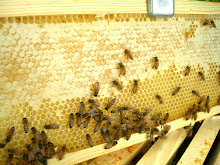
I replaced the frames and inner cover and closed the hive. Here's a shot of the bees gathered at the hive entrance — some going, some coming, some guarding.

Sunday, June 20, 2010

Hopin' for honey.

After seeing how active the bees are and how full the two brood boxes have gotten, I decided it was time to stop feeding the bees. No more sugar water for you, girls! Note to self: stopped feeding on June 15.) I've spotted lots of young bees, so the colony is obviously growing.

Tim suited up and went with me this morning to put on another super. He manned the smoker while I opened the hive. I lifted one frame on the edge of the second box to inspect and it was so heavy! Most of the weight appeared to come from stores of sugar water, but the middle frames are heavy with capped brood. After replacing the frame, I added a queen excluder and another super for honey, and then closed the hive.

It's amazing how much conflicting information is out there about how to manage a hive. So many beekeepers and bee experts advise against using a queen excluder, but there seem to be an equal number who advocate it. Although there is a possibility that I won't harvest any honey this first year (again, some experts say no, some say yes and some say maybe), my reasoning is that if I DO harvest some, I'd like the frames to be brood-free and filled with honey only. The only way to ensure that is to keep the queen out of the honey supers.

My friend and fellow beekeeper Drea phoned this week to say that her hives (now in their second year) are already producing honey in mid-June. The hive with the "aggressive" personality is particularly productive. She'll be harvesting in the next week or two. That's exciting!

Many people have cautioned me that having only one hive could be a mistake. Yet my one hive seems to be thriving. So, maybe there is no right or wrong, or at least more than one way to "bee" successful. Or maybe I'm just lucky with this colony. Time will tell.

ADDENDUM: This evening the bees were clustered in droves on the front of the hive and I was worried they might swarm. After consulting my beginner's beekeeping book, I removed the queen excluder to allow the bees the space of a third super for brood. This was not a fun task in the 92-degree heat, but I'm glad I did it. The bees are already headed back inside to do what they do best.

Saturday, June 12, 2010

I hate yellow jackets.


I hate yellow jackets. Of course I do. I grew up in a Georgia family, immersed in all things UGA. My mother's family is actually full of Georgia Tech grads and one of my best friends is a Tech grad, and I must say they are all wonderful folks...but they instill no love in me for the yellow jacket.

Now I have a reason to hate the varmints even more. Thursday morning, I went out to the hive to feed the bees. Smoker in hand, all went well until I pulled out the empty feeder and...noticed a rogue yellow jacket in the midst of my sweet honey bees. (Aren't the bees supposed to get rid of nasty intruders? Guess they hadn't had a chance yet.) Smoke works well on honey bees, but not on yellow jackets. Smoke makes yellow jackets mad... not that they need much encouragement.

The yellow jacket made a beeline (ha ha) for my leg and stung me. Repeatedly. By the time I disengaged him from my pants leg and hobbled into the house, I could tell this was no ordinary sting. I applied some anti-sting stuff and hoped for the best. I barely slept that night.

By Friday morning the side of my thigh, from hip to knee, was red, swollen and firm to the touch. It looked similar to the bad reaction I had a few years ago when a jellyfish wrapped its tentacles around both my arms in the ocean at St. Simons. I called my doctor's office and she was able to work me in that afternoon. "Ohhhhh, that doesn't look so good," were the first words out of her mouth. I got a shot of prednisone and left with three prescriptions for other medicines to cure me of the evil jellow jacket venom.

So, just a reminder. Honey bees are defensive creatures — they only attack when they perceive their hive is under siege from an outsider. They respond well to smoke. Other winged insects not so much. Yellow jackets, along with hornets and wasps, are aggressive and will sting with very little provocation.

Oh, and Mom? Glad you turned away from the dark side. You chose well. Dawgs are good; jackets are BAD.

Tuesday, June 8, 2010

Bee movie

Today, I made a little film of the bees in action. If you'd like to hear my silly narrative, turn your sound on. Otherwise, just enjoy the bees at work.

Thursday, June 3, 2010

Bees as icebreaker

Over the years I've learned there are several topics that make for great conversation starters in just about any given situation. For example, if you like sports, you will likely find a group of similar-minded folks at almost every social gathering and the talk comes easy. (College football is a popular topic as evidenced by the number of people who crowd around an available TV or Blackberry in the fall, looking for score updates while they attend wedding receptions, parties, business conventions and their kids' soccer games.)


If you're an instigator (like me) of "spirited" conversation, grits is a particularly polarizing subject that gets people going. Most Southerners love grits and most Yankees hate grits, and neither side will give an inch. Well, except for the occasional northern aggressor who admits to eating grits...with sugar on top. Ew! Bless their hearts, they just don't know any better. Besides, their relatives and friends will pull their Yankee card when they go back north to visit and admit they eat grits.

Okay, back to the original point — getting a good conversation going. I've found that bees are a great icebreaker. Recently, I've mentioned my bees at a wedding reception, at the gym, in a business meeting and to the nice lady who cuts my hair, among others. Reactions range from "I've read about the honey bees disappearing," and "Cool! When can I have some honey?" to "Isn't that illegal?" and (courtesy of Greg) "HAVE YOU LOST YOUR MIND?!"

In any case, people are mostly fascinated by bees, even if some are repulsed. They pepper me with questions, information they've heard on the news, memories of relatives who kept bees and tales of bad childhood encounters with bees. No one seems disinterested or even neutral.

Bees are a topic that really creates a buzz!